

Volume 12, Issue 2 (2026)
Pharm Biomed Res 2026, 12(2): 141-148 |
Back to browse issues page



Download citation:
BibTeX | RIS | EndNote | Medlars | ProCite | Reference Manager | RefWorks
Send citation to:


BibTeX | RIS | EndNote | Medlars | ProCite | Reference Manager | RefWorks
Send citation to:
Kordkatouli M, Mahmood Janlou M A, Varasteh Moradi A, Sateei A. First Global Report of the Alkaloids Quebrachamine in Vinca herbacea From Northern Iran Using GC-MS. Pharm Biomed Res 2026; 12 (2) :141-148
URL: http://pbr.mazums.ac.ir/article-1-739-en.html
URL: http://pbr.mazums.ac.ir/article-1-739-en.html


1- Department of Genetics, TeMS.C, Islamic Azad University, Tehran, Iran. & Medicinal Plants Research Center, Go.C, Islamic Azad University, Gorgan, Iran.
2- Department of Cell and Molecular Biology, Go.C, Islamic Azad University, Gorgan, Iran.
3- Medicinal Plants Research Center, Go.C, Islamic Azad University, Gorgan, Iran. & Department of Chemistry, Go.C, Islamic Azad University, Gorgan, Iran.
4- Medicinal Plants Research Center, Go.C, Islamic Azad University, Gorgan, Iran. & Department of Plant Science, Go.C, Islamic Azad University, Gorgan, Iran.
2- Department of Cell and Molecular Biology, Go.C, Islamic Azad University, Gorgan, Iran.
3- Medicinal Plants Research Center, Go.C, Islamic Azad University, Gorgan, Iran. & Department of Chemistry, Go.C, Islamic Azad University, Gorgan, Iran.
4- Medicinal Plants Research Center, Go.C, Islamic Azad University, Gorgan, Iran. & Department of Plant Science, Go.C, Islamic Azad University, Gorgan, Iran.
Full-Text [PDF 1386 kb]
(83 Downloads)
| Abstract (HTML) (224 Views)
Full-Text: (39 Views)
Introduction
Vinca herbacea Waldst. & Kit., a creeping perennial herb belonging to the family Apocynaceae, is considered one of the less-studied species within the genus Vinca. This species naturally occurs in temperate regions of Europe and Asia and is characterized by slender creeping stems, evergreen ovate-lanceolate leaves, and blue-violet flowers. According to the data from the royal botanic gardens, Kew (World Flora Online), V. herbacea is native to several Eurasian countries, including Iran, Turkey, Iraq, Syria, Lebanon, Armenia, Russia, Hungary, Germany, Austria, and Romania; however, GBIF records indicate that its confirmed presence in Iran is primarily restricted to the northern provinces along the Alborz mountain range [1-4]. Within Iran, authenticated occurrences of V. herbacea are largely confined to the mountainous terrains of the ancient Hyrcanian forests in Golestan, Mazandaran, and Gilan provinces [5].
Members of the family Apocynaceae are widely known for producing monoterpenoid indole alkaloids (MIAs)—a class of structurally complex secondary metabolites with potent pharmacological activities. Among these compounds, quebrachamine (C19H26N2; MW=282.4), also known as a naturally occurring indole alkaloid, exhibits remarkable antihypertensive, vasodilatory, neuroprotective, anticancer, antibacterial, and antioxidant effects. It acts as a selective antagonist of α₁-adrenergic receptors, thereby increasing cerebral and peripheral blood flow and protecting neuronal tissues from oxidative stress and ischemic injury. Although the presence of quebrachamine has been widely reported in other Vinca species—particularly Vinca minor—its existence in V. herbacea had not been documented until now [4-8].
Materials and Methods
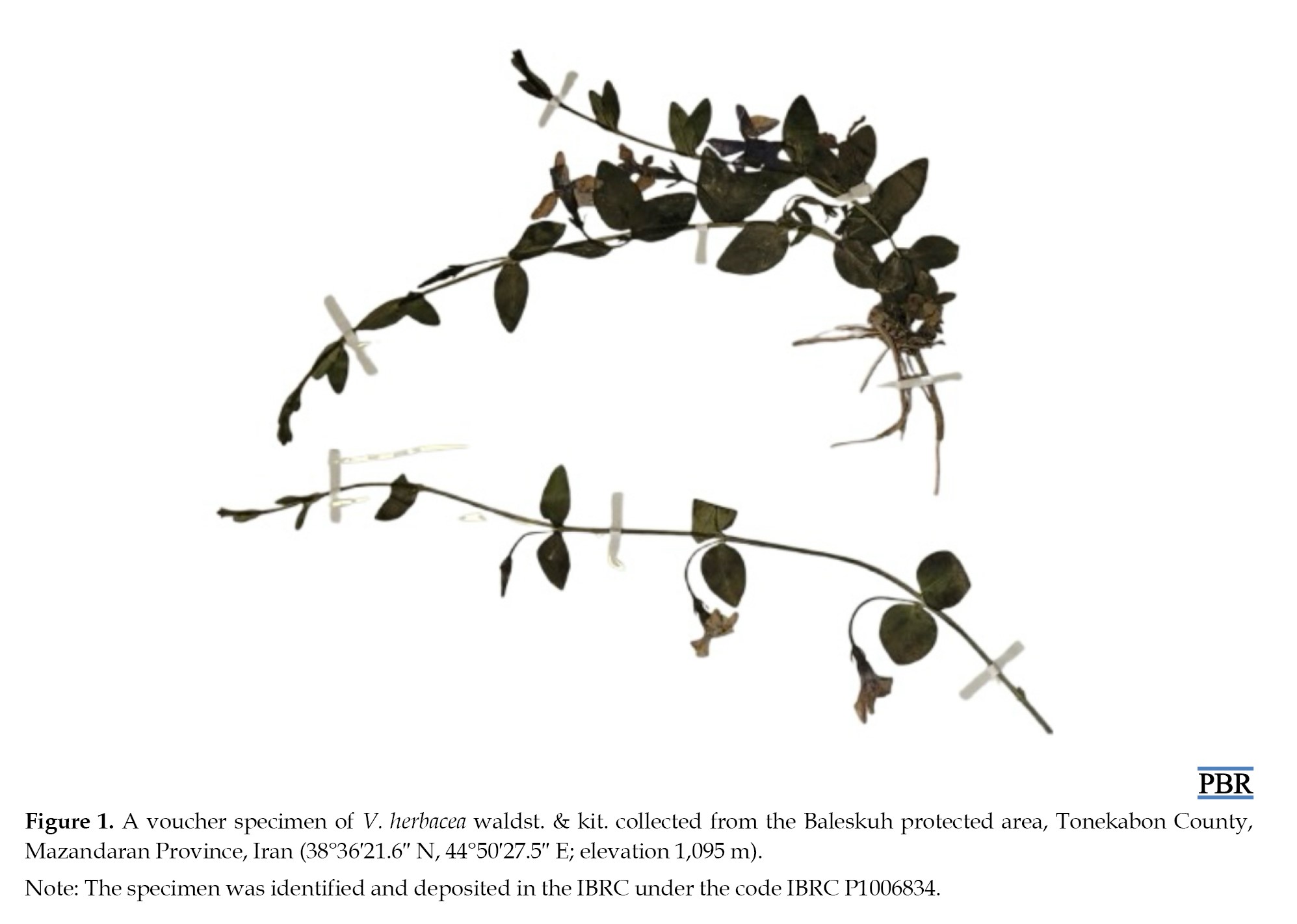
In June 2024, aerial parts (leaves, stems, and flowers) of V. herbacea were collected from the Baleskuh Protected Area, Tonekabon County, Mazandaran Province, Iran. This location lies within the mountainous part of the Hyrcanian forests at coordinates 36°38′21.6″ N, 50°44′27.5″ E, at an elevation of 1,095 meters above sea level. This area features a temperate humid climate with average temperatures ranging from 20 to 30 °C and relative humidity between 70–80% during the growing season—conditions favorable for the biosynthesis of secondary metabolites. The specimens were taxonomically verified by the Iranian biological resource center (IBRC) and deposited under the herbarium code IBRC P1006834 (Figure 1) [3-6].
 A soil specimen was collected from the identical location at a depth of 20 cm, then allowed to air-dry and pass through a sieve before testing. For pH determination, 10 g of the prepared soil was added to 25 mL of distilled water (maintaining a 1:2.5 soil-to-water ratio) and agitated for 30 minutes. The resulting liquid’s pH was measured using a digital pH meter (Model PH827, Metrohm, Switzerland). To determine soil texture, the hydrometer (Horn) technique was employed. This technique involved mixing 50 g of soil with 100 mL of distilled water and 2 mL of 5% sodium hexametaphosphate, which served as a dispersing agent. The suspension was then mixed thoroughly and allowed to separate according to ASTM standard guidelines. The soil exhibited a mildly alkaline reaction (pH 7.2) and a sandy loam texture, with a composition of 60% sand, 30% silt, and 10% clay (Si-L) [5].
The extraction of V. herbacea flowers was performed using the cold maceration method in 3 independent solvent phases. In the first extraction step, the powdered plant material was mixed with 96% ethanol (Merck, Germany) at a ratio of 1 g/10 mL of solvent and kept at 4 °C for 1 week with occasional shaking. After maceration, the mixture was centrifuged at 4000 rpm for 20 min, and the supernatant was filtered through Whatman Grade 1 filter paper. The ethanolic extract was collected and stored separately [9, 10].
The remaining plant residue was subjected to a second extraction step using 96% n-propanol (Merck, Germany) under the same conditions (1 g/10 mL, 4 °C, one week). After maceration, the mixture was again centrifuged and filtered, and the n-propanol extract was collected and stored independently.
In the third extraction step, the plant residue was extracted using 96% butanol (Merck, Germany) following the same procedure (1 g/10 mL, 4 °C, one week). The butanolic extract was also centrifuged, filtered, and stored separately.
Importantly, the extracts obtained from ethanol, n-propanol, and butanol were not combined. Each extract was evaporated individually under reduced pressure using a rotary evaporator (Heidolph Hei-VAP Expert, Germany), dried, and stored in tightly sealed containers at 4 °C.
The gas chromatography-mass spectrometry (GC-MS) analysis was carried out as follows. The chemical constituents of the ethanolic, propanolic, and butanolic extracts of V. herbacea flowers were analyzed separately using an Agilent 6890 gas chromatograph coupled with an Agilent 5973 mass selective detector. For each extract, a 2 µL aliquot of the concentrated sample was injected in split mode (1:5) into an HP-5MS capillary column (30 m×0.25 mm, 1 µm film thickness). Helium (99.999% purity) was used as the carrier gas at a constant flow rate of 1.0 mL/min [3, 5, 6].
The oven temperature was programmed from an initial 60 °C (held for 2 min) to 280 °C at a rate of 5 °C/min, followed by a final hold of 20 min. Mass spectrometry was performed using electron impact ionization at 70 eV with a scanning range of m/z 40–500. Identification of compounds was based on comparisons of retention times and mass spectra with those in the NIST and Wiley spectral libraries [6, 9, 10].
Results
The results for each organ and solvent are as follows.
Stems
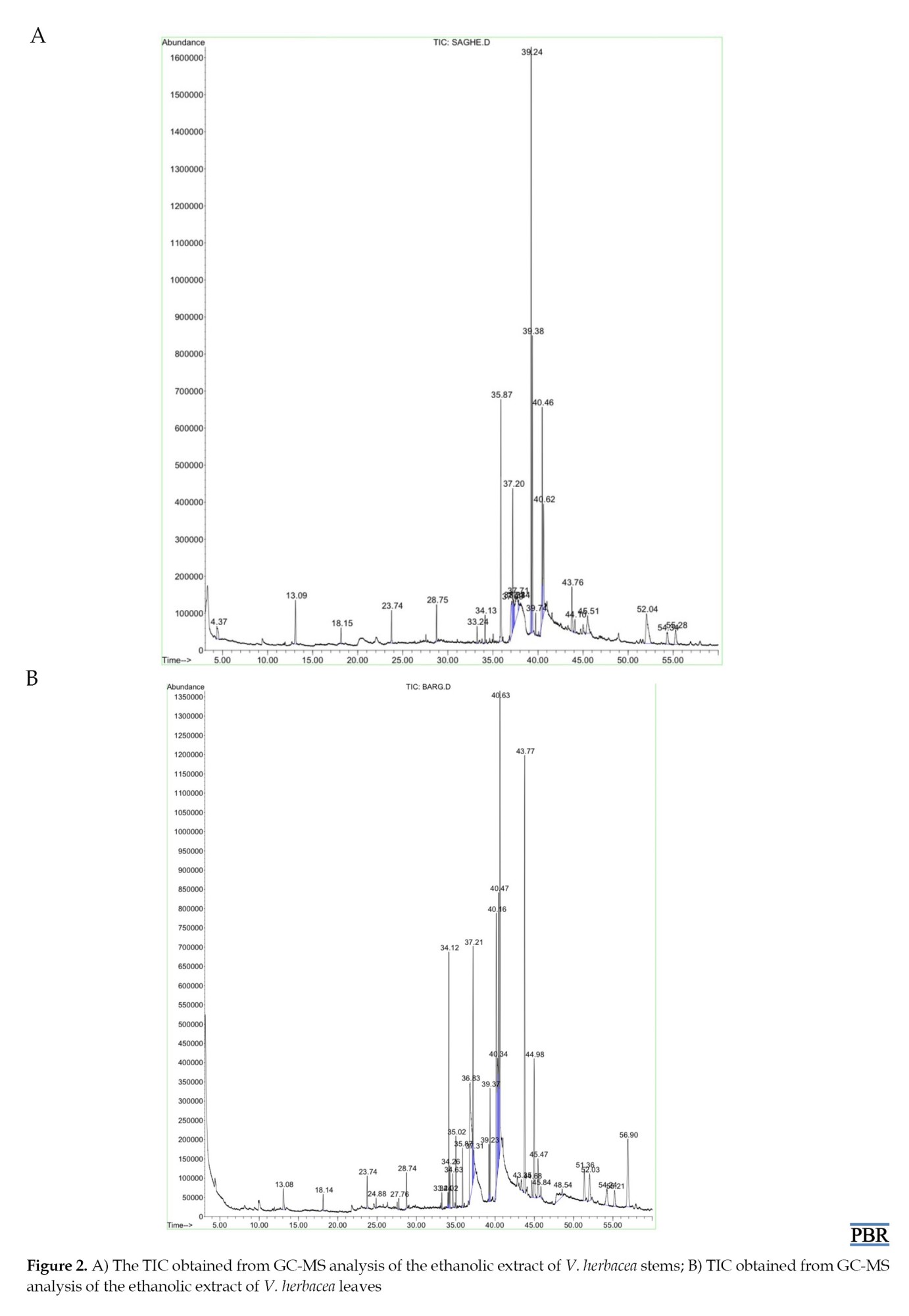
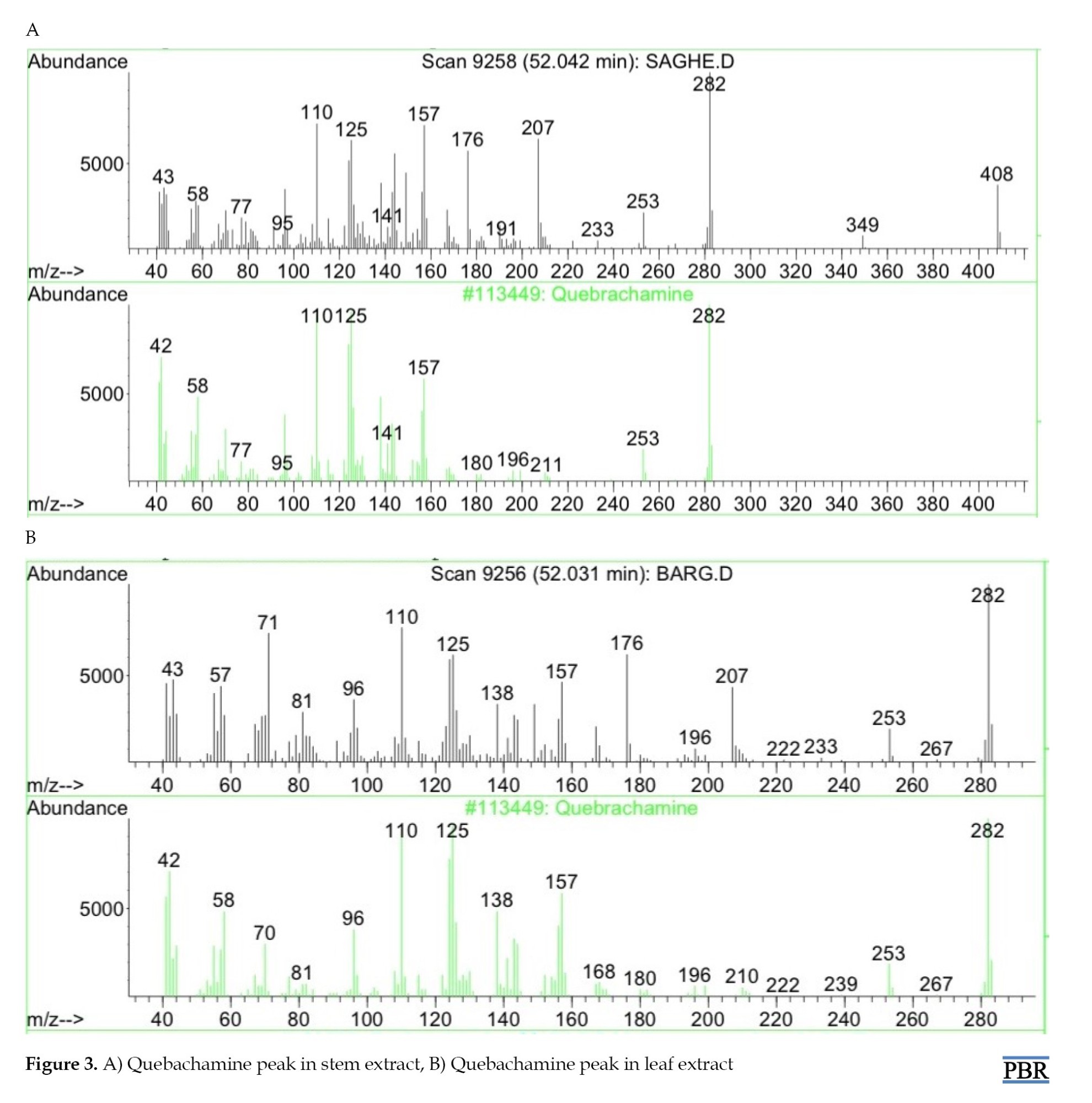
In the ethanolic stem extract, quebrachamine was identified at a retention time of 52.04 minutes. The mass spectral match quality with the Wiley library was 95% and with NIST was 96%, indicating highly accurate and reliable identification of this alkaloid in stem tissue. The relative abundance of quebrachamine in this extract was 6.18% of the total chromatogram, significantly higher than in the ethanolic leaf extract. This finding suggests that stems contain more of this alkaloid than leaves, and that ethanol is more efficient in extracting quebrachamine from stem tissue. This outcome may reflect differences in tissue structure, vascular density, or organ-specific alkaloid distribution (Figures 2A and 3A).
 No peak corresponding to this compound was observed in the n-propanol stem extract. Therefore, it appears that stems contain no detectable amount of quebrachamine under these analytical conditions. Similarly, no peak corresponding to this compound was detected in the n-butanol stem extract.
Leaves
In the ethanolic leaf extract, quebrachamine was identified at a retention time of 52.03 minutes with a match quality of 99% in both Wiley and NIST libraries. This high match accuracy confirms reliable identification. The relative abundance of this compound was 1.71% of the total chromatogram, indicating moderate extractability of the alkaloid from leaves by ethanol (Figures 2B and 3B).
No peak corresponding to this compound was found in either the n-propanol and butanol extracts of the leaves, suggesting that leaves contain very low or undetectable levels of Quebrachamine when extracted with these solvents.
Flowers
In flower tissues, quebrachamine was not detected in the ethanolic extract. This absence may indicate extremely low levels of the compound in floral tissues or low extraction efficiency of ethanol for this alkaloid in flowers.
Similarly, no peak corresponding to this compound was detected in either the n-propanol and butanol extracts of flowers, suggesting that flowers contain no detectable amount of quebrachamine under the applied GC-MS conditions.
Detailed analysis of the GC-MS results showed that the recorded mass spectrum of the detected compound perfectly matched the reference patterns of quebrachamine (CAS: 4850-21-9) in certified spectral libraries. Comparison of spectra with the Wiley and NIST libraries showed match quality (qual) values above 95% in all samples. This high spectral similarity confirms that the detected compound fully corresponds to the known structure of quebrachamine, and its presence in the plant samples is unequivocally verified.
This high-level library match not only ensures the validity of the identification but also highlights the significance of the finding, as the detection of quebrachamine in V. herbacea is reported for the first time and indicates the considerable phytochemical potential of this species.
Discussion
This study represents the first global report of quebrachamine in V. herbacea and the first record from northern Iran. Its presence predominantly in leaves and stems, and the solvent-dependent differences, suggest that biosynthesis of quebrachamine is concentrated in metabolically active, photosynthetic tissues. The minor variations observed in fragmentation patterns among different organs—especially slight differences in ion intensities—are more likely due to natural isotopic distributions and relative abundance differences, rather than enzymatic or accumulation differences [5, 6].
Overall, the available reports on the presence of quebrachamine in the genus Vinca are limited and mainly date back to older studies. These accounts include the report by Rakhimov et al. (1970) on Vinca erecta and the study by Mokrý et al. (1967) on Vinca minor. In these investigations, ethanol was generally used as the extraction solvent; however, the analytical techniques applied differ from those used in the present study. These methodological differences may to some extent limit direct comparison of the results, while at the same time highlighting the importance of employing more up-to-date approaches in the investigation of phytochemical constituents within this genus [11, 12].
The identification of quebrachamine in V. herbacea expands the known phytochemical profile of this understudied species and highlights its potential as a new natural source of valuable indole alkaloids. Given the strong vasodilatory, neuroprotective, and antioxidant properties of this compound, further confirmatory studies, preparative high-performance liquid chromatography (Prep-HPLC) isolation, and full structural elucidation using nuclear magnetic resonance (NMR) spectroscopy are strongly recommended. Additionally, in vitro bioassays to evaluate antihypertensive, neuroprotective, and radical-scavenging activities of purified quebrachamine, as well as chemotypic studies among different Iranian populations, could illuminate the influence of environmental factors on its biosynthesis [3-5].
Conclusion
This study provides the first global report of quebrachamine presence in V. herbacea and highlights the phytochemical and pharmacological potential of this lesser-known species as a promising natural source of bioactive compounds. These findings further emphasize the need for enhanced conservation measures for this rare and scattered species, including preservation through tissue culture, enabling large-scale propagation, and developing cultivation under controlled conditions such as farms, greenhouses, or as an agricultural crop to ensure sustainable and economically viable utilization. Considering that Iran represents one of the natural habitats of this species, focused efforts on its conservation, alongside comprehensive phytochemical, biological, and ecological studies, are essential to safeguard its genetic resources and to facilitate its scientific and applied exploitation.
The total ion chromatogram (TIC) obtained from GC–MS analysis of the ethanolic extracts of V. herbacea leaf and stem tissues revealed a distinct diagnostic peak corresponding to Quebrachamine (CAS: 4850-21-9). In the TIC profile of the leaf extract, this peak appeared at a retention time of 52.03 min with a match quality of 99%, while in the stem extract TIC, the same compound eluted at 52.04 min with a match quality of 96%. The high consistency in retention times and spectral matching across both TIC profiles confirms the presence of Quebrachamine in both tissues, demonstrating that V. herbacea serves as a natural source of this indole alkaloid, with a marginally higher identification confidence observed in the leaf tissue.
The GC-MS analysis of the ethanolic extracts of both the stem and leaf of V. herbacea revealed a clear diagnostic peak corresponding to quebrachamine (CAS: 4850-21-9). The leaf extract displayed a match quality of 99% with a retention time of 52.03 min, while the stem extract showed a match quality of 96% with a retention time of 52.04 min. These highly consistent spectral and chromatographic characteristics confirm the presence of quebrachamine in both tissues, indicating that V. herbacea serves as a natural source of this indole alkaloid, with slightly higher identification confidence in the leaf.
Ethical Considerations
Compliance with ethical guidelines
There were no ethical considerations to be considered in this research.
Funding
This research did not receive any grant from funding agencies in the public, commercial, or non-profit sectors.
Authors' contributions
Conceptualization: Aryan Sateei and Mohammad Kordkatouli; Data curation: Mohammad Kordkatouli and Aryan Sateei; Formal analysis and validation: Mehr Ali Mahmood Janlou and Ali Varasteh Moradi; Funding acquisition: Mohammad Kordkatouli; Investigation and project administration Mohammad Kordkatouli, Ali Varasteh Moradi, and Aryan Sateei; Methodology: Mohammad Kordkatouli and Mehr Ali Mahmood Janlou; Resources: Mohammad Kordkatouli, Ali Varasteh Moradi; Supervision: Ali Varasteh Moradi and Aryan Sateei; Visualization and writing the original draft: Mohammad Kordkatouli and Mehr Ali Mahmood Janlou; Review and editing: Ali Varasteh Moradi and Aryan Sateei.
Conflict of interest
The authors declared no conflict of interest.
Acknowledgments
The authors sincerely express their gratitude to the Islamic Azad University, Gorgan Branch, for its valuable spiritual support and continuous encouragement, as well as for providing access to laboratory facilities and equipment. Special thanks are also extended to the Medicinal Plants Research Center, Islamic Azad University, Gorgan Branch, for generously providing research facilities and sustained support.
The authors gratefully acknowledge the Islamic Republic of Iran Meteorological Organization for kindly supplying the meteorological data of Tonekabon County. The authors also wish to thank the Iranian Biological Resource Center for providing the plant samples, their continuous support and assistance, and for supplying additional information on the geographical distribution and the confirmation of the herbarium specimen.
References
Vinca herbacea Waldst. & Kit., a creeping perennial herb belonging to the family Apocynaceae, is considered one of the less-studied species within the genus Vinca. This species naturally occurs in temperate regions of Europe and Asia and is characterized by slender creeping stems, evergreen ovate-lanceolate leaves, and blue-violet flowers. According to the data from the royal botanic gardens, Kew (World Flora Online), V. herbacea is native to several Eurasian countries, including Iran, Turkey, Iraq, Syria, Lebanon, Armenia, Russia, Hungary, Germany, Austria, and Romania; however, GBIF records indicate that its confirmed presence in Iran is primarily restricted to the northern provinces along the Alborz mountain range [1-4]. Within Iran, authenticated occurrences of V. herbacea are largely confined to the mountainous terrains of the ancient Hyrcanian forests in Golestan, Mazandaran, and Gilan provinces [5].
Members of the family Apocynaceae are widely known for producing monoterpenoid indole alkaloids (MIAs)—a class of structurally complex secondary metabolites with potent pharmacological activities. Among these compounds, quebrachamine (C19H26N2; MW=282.4), also known as a naturally occurring indole alkaloid, exhibits remarkable antihypertensive, vasodilatory, neuroprotective, anticancer, antibacterial, and antioxidant effects. It acts as a selective antagonist of α₁-adrenergic receptors, thereby increasing cerebral and peripheral blood flow and protecting neuronal tissues from oxidative stress and ischemic injury. Although the presence of quebrachamine has been widely reported in other Vinca species—particularly Vinca minor—its existence in V. herbacea had not been documented until now [4-8].
Materials and Methods
In June 2024, aerial parts (leaves, stems, and flowers) of V. herbacea were collected from the Baleskuh Protected Area, Tonekabon County, Mazandaran Province, Iran. This location lies within the mountainous part of the Hyrcanian forests at coordinates 36°38′21.6″ N, 50°44′27.5″ E, at an elevation of 1,095 meters above sea level. This area features a temperate humid climate with average temperatures ranging from 20 to 30 °C and relative humidity between 70–80% during the growing season—conditions favorable for the biosynthesis of secondary metabolites. The specimens were taxonomically verified by the Iranian biological resource center (IBRC) and deposited under the herbarium code IBRC P1006834 (Figure 1) [3-6].
The extraction of V. herbacea flowers was performed using the cold maceration method in 3 independent solvent phases. In the first extraction step, the powdered plant material was mixed with 96% ethanol (Merck, Germany) at a ratio of 1 g/10 mL of solvent and kept at 4 °C for 1 week with occasional shaking. After maceration, the mixture was centrifuged at 4000 rpm for 20 min, and the supernatant was filtered through Whatman Grade 1 filter paper. The ethanolic extract was collected and stored separately [9, 10].
The remaining plant residue was subjected to a second extraction step using 96% n-propanol (Merck, Germany) under the same conditions (1 g/10 mL, 4 °C, one week). After maceration, the mixture was again centrifuged and filtered, and the n-propanol extract was collected and stored independently.
In the third extraction step, the plant residue was extracted using 96% butanol (Merck, Germany) following the same procedure (1 g/10 mL, 4 °C, one week). The butanolic extract was also centrifuged, filtered, and stored separately.
Importantly, the extracts obtained from ethanol, n-propanol, and butanol were not combined. Each extract was evaporated individually under reduced pressure using a rotary evaporator (Heidolph Hei-VAP Expert, Germany), dried, and stored in tightly sealed containers at 4 °C.
The gas chromatography-mass spectrometry (GC-MS) analysis was carried out as follows. The chemical constituents of the ethanolic, propanolic, and butanolic extracts of V. herbacea flowers were analyzed separately using an Agilent 6890 gas chromatograph coupled with an Agilent 5973 mass selective detector. For each extract, a 2 µL aliquot of the concentrated sample was injected in split mode (1:5) into an HP-5MS capillary column (30 m×0.25 mm, 1 µm film thickness). Helium (99.999% purity) was used as the carrier gas at a constant flow rate of 1.0 mL/min [3, 5, 6].
The oven temperature was programmed from an initial 60 °C (held for 2 min) to 280 °C at a rate of 5 °C/min, followed by a final hold of 20 min. Mass spectrometry was performed using electron impact ionization at 70 eV with a scanning range of m/z 40–500. Identification of compounds was based on comparisons of retention times and mass spectra with those in the NIST and Wiley spectral libraries [6, 9, 10].
Results
The results for each organ and solvent are as follows.
Stems
In the ethanolic stem extract, quebrachamine was identified at a retention time of 52.04 minutes. The mass spectral match quality with the Wiley library was 95% and with NIST was 96%, indicating highly accurate and reliable identification of this alkaloid in stem tissue. The relative abundance of quebrachamine in this extract was 6.18% of the total chromatogram, significantly higher than in the ethanolic leaf extract. This finding suggests that stems contain more of this alkaloid than leaves, and that ethanol is more efficient in extracting quebrachamine from stem tissue. This outcome may reflect differences in tissue structure, vascular density, or organ-specific alkaloid distribution (Figures 2A and 3A).
Leaves
In the ethanolic leaf extract, quebrachamine was identified at a retention time of 52.03 minutes with a match quality of 99% in both Wiley and NIST libraries. This high match accuracy confirms reliable identification. The relative abundance of this compound was 1.71% of the total chromatogram, indicating moderate extractability of the alkaloid from leaves by ethanol (Figures 2B and 3B).
No peak corresponding to this compound was found in either the n-propanol and butanol extracts of the leaves, suggesting that leaves contain very low or undetectable levels of Quebrachamine when extracted with these solvents.
Flowers
In flower tissues, quebrachamine was not detected in the ethanolic extract. This absence may indicate extremely low levels of the compound in floral tissues or low extraction efficiency of ethanol for this alkaloid in flowers.
Similarly, no peak corresponding to this compound was detected in either the n-propanol and butanol extracts of flowers, suggesting that flowers contain no detectable amount of quebrachamine under the applied GC-MS conditions.
Detailed analysis of the GC-MS results showed that the recorded mass spectrum of the detected compound perfectly matched the reference patterns of quebrachamine (CAS: 4850-21-9) in certified spectral libraries. Comparison of spectra with the Wiley and NIST libraries showed match quality (qual) values above 95% in all samples. This high spectral similarity confirms that the detected compound fully corresponds to the known structure of quebrachamine, and its presence in the plant samples is unequivocally verified.
This high-level library match not only ensures the validity of the identification but also highlights the significance of the finding, as the detection of quebrachamine in V. herbacea is reported for the first time and indicates the considerable phytochemical potential of this species.
Discussion
This study represents the first global report of quebrachamine in V. herbacea and the first record from northern Iran. Its presence predominantly in leaves and stems, and the solvent-dependent differences, suggest that biosynthesis of quebrachamine is concentrated in metabolically active, photosynthetic tissues. The minor variations observed in fragmentation patterns among different organs—especially slight differences in ion intensities—are more likely due to natural isotopic distributions and relative abundance differences, rather than enzymatic or accumulation differences [5, 6].
Overall, the available reports on the presence of quebrachamine in the genus Vinca are limited and mainly date back to older studies. These accounts include the report by Rakhimov et al. (1970) on Vinca erecta and the study by Mokrý et al. (1967) on Vinca minor. In these investigations, ethanol was generally used as the extraction solvent; however, the analytical techniques applied differ from those used in the present study. These methodological differences may to some extent limit direct comparison of the results, while at the same time highlighting the importance of employing more up-to-date approaches in the investigation of phytochemical constituents within this genus [11, 12].
The identification of quebrachamine in V. herbacea expands the known phytochemical profile of this understudied species and highlights its potential as a new natural source of valuable indole alkaloids. Given the strong vasodilatory, neuroprotective, and antioxidant properties of this compound, further confirmatory studies, preparative high-performance liquid chromatography (Prep-HPLC) isolation, and full structural elucidation using nuclear magnetic resonance (NMR) spectroscopy are strongly recommended. Additionally, in vitro bioassays to evaluate antihypertensive, neuroprotective, and radical-scavenging activities of purified quebrachamine, as well as chemotypic studies among different Iranian populations, could illuminate the influence of environmental factors on its biosynthesis [3-5].
Conclusion
This study provides the first global report of quebrachamine presence in V. herbacea and highlights the phytochemical and pharmacological potential of this lesser-known species as a promising natural source of bioactive compounds. These findings further emphasize the need for enhanced conservation measures for this rare and scattered species, including preservation through tissue culture, enabling large-scale propagation, and developing cultivation under controlled conditions such as farms, greenhouses, or as an agricultural crop to ensure sustainable and economically viable utilization. Considering that Iran represents one of the natural habitats of this species, focused efforts on its conservation, alongside comprehensive phytochemical, biological, and ecological studies, are essential to safeguard its genetic resources and to facilitate its scientific and applied exploitation.
The total ion chromatogram (TIC) obtained from GC–MS analysis of the ethanolic extracts of V. herbacea leaf and stem tissues revealed a distinct diagnostic peak corresponding to Quebrachamine (CAS: 4850-21-9). In the TIC profile of the leaf extract, this peak appeared at a retention time of 52.03 min with a match quality of 99%, while in the stem extract TIC, the same compound eluted at 52.04 min with a match quality of 96%. The high consistency in retention times and spectral matching across both TIC profiles confirms the presence of Quebrachamine in both tissues, demonstrating that V. herbacea serves as a natural source of this indole alkaloid, with a marginally higher identification confidence observed in the leaf tissue.
The GC-MS analysis of the ethanolic extracts of both the stem and leaf of V. herbacea revealed a clear diagnostic peak corresponding to quebrachamine (CAS: 4850-21-9). The leaf extract displayed a match quality of 99% with a retention time of 52.03 min, while the stem extract showed a match quality of 96% with a retention time of 52.04 min. These highly consistent spectral and chromatographic characteristics confirm the presence of quebrachamine in both tissues, indicating that V. herbacea serves as a natural source of this indole alkaloid, with slightly higher identification confidence in the leaf.
Ethical Considerations
Compliance with ethical guidelines
There were no ethical considerations to be considered in this research.
Funding
This research did not receive any grant from funding agencies in the public, commercial, or non-profit sectors.
Authors' contributions
Conceptualization: Aryan Sateei and Mohammad Kordkatouli; Data curation: Mohammad Kordkatouli and Aryan Sateei; Formal analysis and validation: Mehr Ali Mahmood Janlou and Ali Varasteh Moradi; Funding acquisition: Mohammad Kordkatouli; Investigation and project administration Mohammad Kordkatouli, Ali Varasteh Moradi, and Aryan Sateei; Methodology: Mohammad Kordkatouli and Mehr Ali Mahmood Janlou; Resources: Mohammad Kordkatouli, Ali Varasteh Moradi; Supervision: Ali Varasteh Moradi and Aryan Sateei; Visualization and writing the original draft: Mohammad Kordkatouli and Mehr Ali Mahmood Janlou; Review and editing: Ali Varasteh Moradi and Aryan Sateei.
Conflict of interest
The authors declared no conflict of interest.
Acknowledgments
The authors sincerely express their gratitude to the Islamic Azad University, Gorgan Branch, for its valuable spiritual support and continuous encouragement, as well as for providing access to laboratory facilities and equipment. Special thanks are also extended to the Medicinal Plants Research Center, Islamic Azad University, Gorgan Branch, for generously providing research facilities and sustained support.
The authors gratefully acknowledge the Islamic Republic of Iran Meteorological Organization for kindly supplying the meteorological data of Tonekabon County. The authors also wish to thank the Iranian Biological Resource Center for providing the plant samples, their continuous support and assistance, and for supplying additional information on the geographical distribution and the confirmation of the herbarium specimen.
References
- World Flora Online. Vinca herbacea Waldst. & Kit [Internet]. 2024 [Updated 2025 December 17]. Available from: [Link]
- Global Biodiversity Information Facility. Vinca herbacea Waldst. & Kit [Internet]. 2024 [Updated 2026 June 7]. Available from: [Link]
- Kordkatouli M, Sateei A. The first global report on the alkaloid aspidospermidine in Vinca herbacea: A potential source of anticancer alkaloid precursors. Fut Nat Prod. 2025; 10(2):109-13. [DOI:10.34172/fnp.323]
- Kordkatouli M, Sateei A, Khoshbakht T. Antitumor potential of Vinca herbacea and its molecular pathways in inhibiting cancer cell growth. Immunoregulation. 2024; 7(1):1-7. [DOI:10.32598/Immunoregulation.7.7]
- Kordkatouli M, Mahmood Janlou MA, Varasteh Moradi A, Rizwan M, Sateei A, Javidi MA. The first global report of vindolinine in Vinca herbacea from the hyrcanian floristic region: GC-MS identification and potential anticancer relevance. Immunoregulation. 2025; 8(1):1-7. [DOI:10.32598/Immunoregulation.8.19]
- Kordkatouli M, Moradi AV, Javidi MA, Sateei A, Dulskas A, Luniene D. First global report of alkaloids tubotaiwine and vinervine in Vinca herbacea: Potential pharmacological applications. Basic Clin Cancer Res. 2024; 16(4):180-2. [Link]
- Vrabec R, Drašar P, Opletal L, Kosturko Š, Blunden G, Cahlíková L. Alkaloids from the genus Vinca L.(Apocynaceae): A comprehensive biological and structural review. Phytochem Rev. 2025; 24:3735–65. [DOI:10.1007/s11101-025-10102-z]
- Neculai AM, Stanciu G, Mititelu M. Determination of active ingredients, mineral composition and antioxidant properties of hydroalcoholic macerates of vinca minor l. plant from the dobrogea area. Molecules. 2023; 28(15):5667. [DOI:10.3390/molecules28155667] [PMID]
- Koohsari H, Kordkatouli M, Sateei A, Janlou MA. GC-MS analysis and antibacterial activity of terminalia chebula against β-lactam-resistant kelebsiella pneumoniae. Immunoregulation.2024; 7(1):1-7. [DOI:10.32598/Immunoregulation.7.13]
- Mahmood Janlou MA, Kordkatouli M, Sateei A, Koohsari H. Gc-Ms-based phytochemical profiling and antibacterial efficacy of terminalia chebula extract against gastrointestinal pathogens resistant to β-lactam antibiotics. J Patient Saf Qual Improv. 2025; 13(3):169-78. [DOI:10.22038/psj.2025.89635.1477]
- Rakhimov DA, Sharipov MR, Aripov KN, Malikov VM, Shakirov TT, Yunusov SY. The polybuffer separation of the alkaloids of Vinca erecta. Chem Nat Comp. 1970; 6(6):724-7. [DOI:10.1007/BF00565343]
- Mokrý J, Kompiš I, Spiteller G. Alkaloids from Vinca minor L. XX. Further minor alkaloids. Collect Czechoslovak Commun. 1967; 32(7):2523-31. [DOI:10.1135/cccc19672523]
Type of Study: Letter to Editor |
Subject:
Pharmacognosy
| Rights and permissions | |
 |
This work is licensed under a Creative Commons Attribution-NonCommercial 4.0 International License. |

This is an open access article distributed under the terms of the Creative Commons Attribution License (CC-By-NC), which permits use, distribution, and reproduction in any medium, provided the original work is properly cited and is not used for commercial purposes.
Contact Information