

Volume 12, Issue 2 (2026)
Pharm Biomed Res 2026, 12(2): 133-140 |
Back to browse issues page



Download citation:
BibTeX | RIS | EndNote | Medlars | ProCite | Reference Manager | RefWorks
Send citation to:


BibTeX | RIS | EndNote | Medlars | ProCite | Reference Manager | RefWorks
Send citation to:
Karimi-shahri M R, Rahamouz-Haghighi S, Honarmand A, Taheri E. In Vitro Antibacterial Activity of Medicinal Plant Essential Oils Against Burkholderia gladioli pv. gladioli. Pharm Biomed Res 2026; 12 (2) :133-140
URL: http://pbr.mazums.ac.ir/article-1-702-en.html
URL: http://pbr.mazums.ac.ir/article-1-702-en.html


1- Department of Plant Protection, Khorasan Razavi Agricultural & Natural Resources Research Center, Agricultural Research, Education and Extension Organization (AREEO), Mashhad, Iran.
2- Department of Plant Protection, Faculty of Agriculture, Azarbaijan Shahid Madani University, Tabriz, Iran.
2- Department of Plant Protection, Faculty of Agriculture, Azarbaijan Shahid Madani University, Tabriz, Iran.
Keywords: Antibacterial activity, essential oils, Burkholderia gladioli, Crocus sativus L., Pesticide-free crop protection, Saffron
Full-Text [PDF 683 kb]
(76 Downloads)
| Abstract (HTML) (251 Views)
Full-Text: (41 Views)
Introduction
Crocus sativus L. (Saffron, known as ‘Red Gold’) is a perennial autumn flowering plant that belongs to the Iridacea family plants. The dried stigma of the saffron plant is the most expensive spice and has a critical role in non-oil exporting economy of Iran [1]. The genus Crocus (Iridaceae) currently includes 261 species worldwide [2], with 24 species recognized in Iran [3]. According to the agronomic, physiological and biological traits of C. sativus, it could exploit marginal land and can substitute applicable crops in low-input cropping systems for sustainable agriculture [4]. Two possible origin areas have been reported for saffron: The Mediterranean area (Greece) and the East, especially Turkey, Iran, and India [5]. Saffron is mainly cultivated in Iran, Afghanistan, India, Morocco, Italy, Spain, and Greece. Iran, with 90% of the global saffron production, is largest producer in the world with an average yield of 3.53 kg ha1 (108000 ha) in 2017 (Razavi Khorasan Province with 84738 ha is main area in Iran) [6].
The most important bacterial pathogens of saffron corms are Burkholderia gladioli pv. gladioli and Bacillus croci [7]. B. gladioli pv. gladioli cause soft rot of emerging leaves and shoots and spots on corms and leaves in saffron and reduced flowering by approximately 80% [8]. Pathovars of B. gladioli have various host plants like species of Crocus and Iris, and also cause grain rot and leaf-sheath browning in rice and soft rot in onion [9]. Phytopathogenic strains of B. gladioli were divided into two pathovars (gladioli and alliicola) based on plant host and nutrition differences [10]. Using biochemical and molecular methods for bacterial isolate identification, Karimi-Shari et al. reported the first account of B. gladioli in saffron corms from Khorasan Razavi fields, Iran [11].
Two partial genomes of B. gladioli strains have been submitted in GenBank (13B 16S ribosomal RNA gene, Accession number: OP183349 and 13A 16S-23S ribosomal RNA, Accession number: OP218019) in 2022. This bacterium in Iran causes severely reduce saffron yields each year. Infected plants showed early leaf yellowing and draying. On the corms, decaying signs on the sheaths while some newly formed sprouts had tissue burnings and browning were observed. Furthermore, a ring shape red brown discoloration on the root germination zone of some infected saffron corms were observed that gradually decayed and extended to the deep corm. According to responsible authorities (plant protection organization) of Iran, no pesticides are registered or recommended in any level for saffron cultivations (except for two herbicides) [12]. Considering Iran’s substantial saffron exports, which require pesticide-free products, developing alternative control methods is critical. Most essential oils are classified as generally recognized as safe. They consist of volatile secondary metabolites extracted from various plant parts and possess bioactive properties such as anti-inflammatory, antibacterial, preservative, and decontaminant effects. Some components like carvacrol, resorcylic acid, eugenol, cinnamaldehyde, trans-cinnamaldehyde, vanillin, and thymol mainly have antibacterial activity [13].
Among the plant families, Lamiaceae plants have most and effective spices with high level of essential oils. Satureja hortensis L. (Summer savory; Marze in Persian) and Thymus vulgaris L. belong to the Lamiaceae family. S. hortensis is an aromatic annual plant with cosmopolitan distribution that is cultivated across the world; it is traditionally used as a natural food preservative, spice, anti-inflammatory, antifungal and antibacterial agent [14]. T. vulgaris (Thyme; Avishan in Persian), is an evergreen perennial, woody plant and indigenous to the Mediterranean region, parts of Asia and Northern Africa. T. vulgaris is cultivated around the world and people have used it as a culinary and flavoring agent as well as an herbal medicine. T. vulgaris has antibiotic, antiseptic, and antifungal activities [15]. Sclerorhachis leptoclada Rech. (Compositae) (Mastar in Persian) is an aromatic perennial plant used as an herbal medicine (aerial parts); it is useful for blood purification, increasing lactation, headache, treating digestive disorders and body pains [16]. Trachyspermum ammi (L.) Sprague (Apiaceae) (Ajwain; Zeniyan in Persian) is an aromatic annual herb that originated in India, Middle East, Iran, Egypt and Afghanistan and is also cultivated in many countries as medicinal, culinary and for the food, flavoring and spices industries.
T. ammi has some biological activity consisting of antioxidant, antimicrobial, and antiviral properties [17]. T. ammi exhibits diverse biological activities, including antioxidant, antimicrobial, and antiviral properties. Its methanolic and ethanolic extracts and essential oil demonstrated maximum inhibitory activity against Staphylococcus aureus [18, 19]. According to the literature, there is one study concerning antibacterial effects of essential oils against B. gladioli, which examined the antibacterial effect of clover on Tremella fuciformis Berk. (1856) (Fungi: Tremellaceae) as the host of pathogen [20]. Other studies have focused on other species of Burkholderia, such as Burkholderia cepacia complex [21-23], and B. glumae [24]. This study aimed to screen essential oils from 25 medicinal plants for their potent antibacterial activity against B. gladioli, a bacterial pathogen that reduces saffron yields in Iran, promoting pesticide-free crop protection.
Materials and Methods
Plants materials
All plants have been collected from South and Razavi Khorasan, Iran, during spring and summer of 2022 (Table 1).
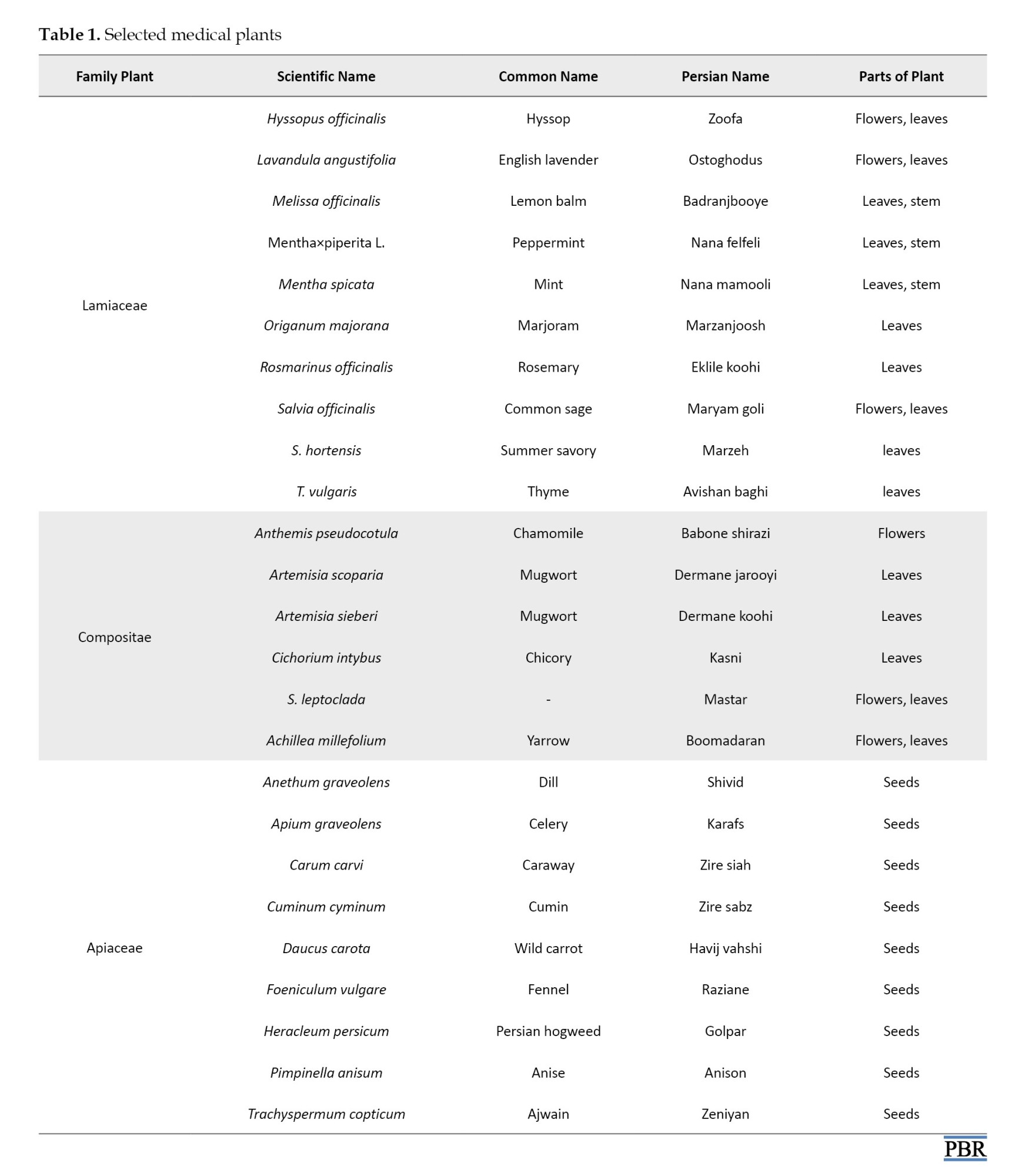
Plants species were identified by a Botanist (Khorasan Razavi Agricultural & Natural resources Research Center) and dried for 2-3 weeks at 4 °C in shade. Plant materials were ground into a fine powder by an electric grinder and preserved in brown and isolated glass and stored in 4 °C until use.
Essential oil extraction
To extract essential oils from plant material, the clevenger apparatus type was used via the hydro-distillation method, following the standard procedure of the European pharmacopoeia (European pharmacopoeia. 2004, France). Fifty grams of powdered plant material and 500 mL of distilled water were added to a Pyrex extraction flask. After 3 h, essential oils were extracted from the aqueous layer and sodium sulfate anhydrous (Na2SO4) was used to dehydrate the essential oils. Dehydrated essential oils were stored in brown and isolated glasses at 4 °C until use.
Microorganisms
B. gladioli pv. gladioli (strain code: 150) was obtained from the culture collection of Khorasan Razavi Agricultural & Natural Resources Research Center, Iran. Strain 150 was isolated from infected saffron corm that collected from Khorasan Razavi saffron Field. This strain was cultured on nutrient agar (NA) and nutrient broth (NB) at 28 °C.
The disk diffusion assay
The bacterial isolate was cultured in NB at 28 °C for 48 h. After incubation, a suspension with a concentration of 10⁸ CFU/mL was prepared using sterile distilled water. Subsequently, 100 μL of the suspension was evenly spread on the surface of NA using a sterilized glass inoculating loop. The antibacterial activity was evaluated using a modified disk diffusion assay [14]. The bacterial suspension was allowed to absorb on the NA for 10 min at room temperature. Five microliters of each essential oil was added to a paper disk (5 mm diameter- Whatman No.1) and placed in the center of the NA surface. Amikacin 30 µg disk and dimethyl sulfoxide 10% (DMSO) were used as positive and negative controls, respectively [25]. All treatments (3 replicates) were incubated at 26 °C for 48 h. The inhibition zone (mm) was measured using a caliper.
Minimum inhibitory concentration (MIC) and minimum bactericidal concentration (MBC)
For treatments with visible halos from disk diffusion assay, MIC was assessed via the modified microdilution protocol of Mihajilov-Krstev et al. [26]. Strain 150 was cultured in NB at 28 °C for 48 h. 1000 μL sterilized NB plus 10 μL DMSO were added to a sterile microtube (2 mL). Then, 32 μL of each essential oils were added to the microtube to obtain 32 µL/mL at first microtube and two-fold dilution was used to make 16, 8, 4, 2, 1, 0.5, 0.25 and 0.12 µL/mL concentrations. A total of 10 µL/mL of bacterial suspension (106 CFU/mL) was inoculated to each microtube and incubated on a shaker oven (300 rpm, 28 °C) for 48 h. After confirming bacterial growth (turbidity) in the control, 200 μL from each microtube was transferred to 96-well microplates, and MIC values were determined using an ELISA reader (model: ELx800; wavelength: 630 nm). One thousand microliters of sterilized NB plus 10 μL DMSO was considered as the negative control and 1000 μL NB plus 10 μL DMSO inoculated with 10 µL/mL of bacterial suspension (106 CFU/mL) was used as the positive control. To determine MBC, NA plates were streaked from each treatment showing no growth at the lowest essential oil concentration.
Results
The antibacterial activities of essential oils derived from 25 medicinal plants were evaluated against B. gladioli (strain code: 150). Among the tested essential oils, 4 exhibited significant in vitro antibacterial effects. These oils included S. hortensis and T. vulgaris from the Lamiaceae family, T. ammi from the Apiaceae family, and S. leptoclada from the Compositae family. The diameters of the inhibition zones produced by these effective essential oils are summarized in Table 2.
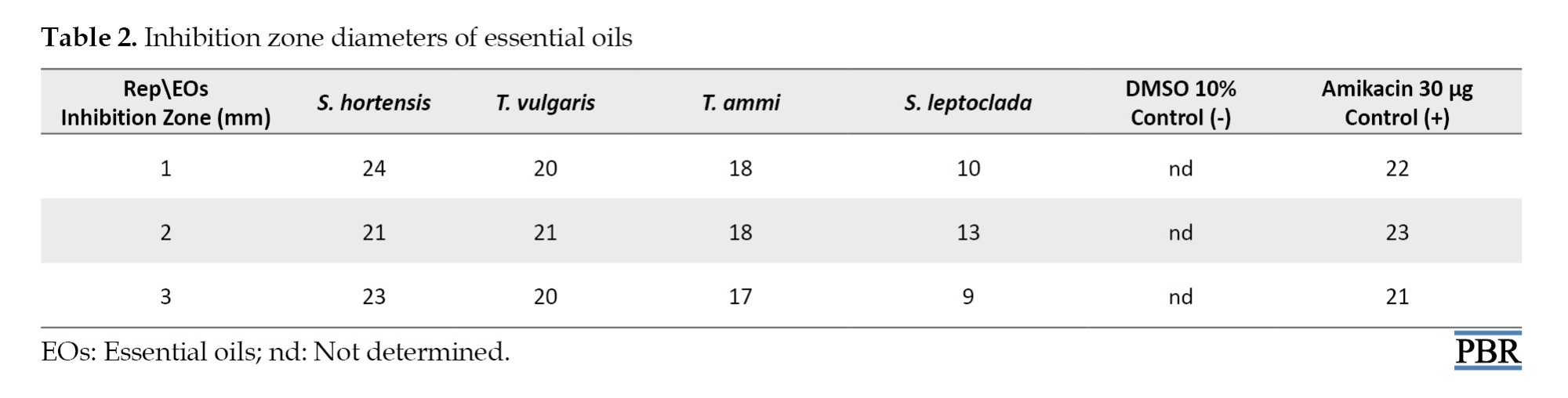
The negative control, 10% DMSO, did not produce any inhibition zones in the disk diffusion assay. S. hortensis essential oil generated the largest inhibition zone with an average diameter of 22.66 mm, comparable to the positive control Amikacin (30 µg) (P<0.05), which produced an average inhibition zone of 22.00 mm. The inhibition zone of T. vulgaris (20.33 mm) was comparable to that of S. hortensis, while T. ammi (17.66 mm) and S. leptoclada (10.66 mm) exhibited weaker effects. Spectrophotometric turbidity measurements indicated that absorption coefficients ranging from 0.70 to 1.00 corresponded to full bacterial growth (positive control: Nutrient broth (NB)+DMSO+bacteria), while values between 0.03 and 0.10 indicated inhibited growth (negative control: NB+DMSO) after 48 h at 28 °C. The MIC assay results confirmed the disk diffusion findings (Table 3).
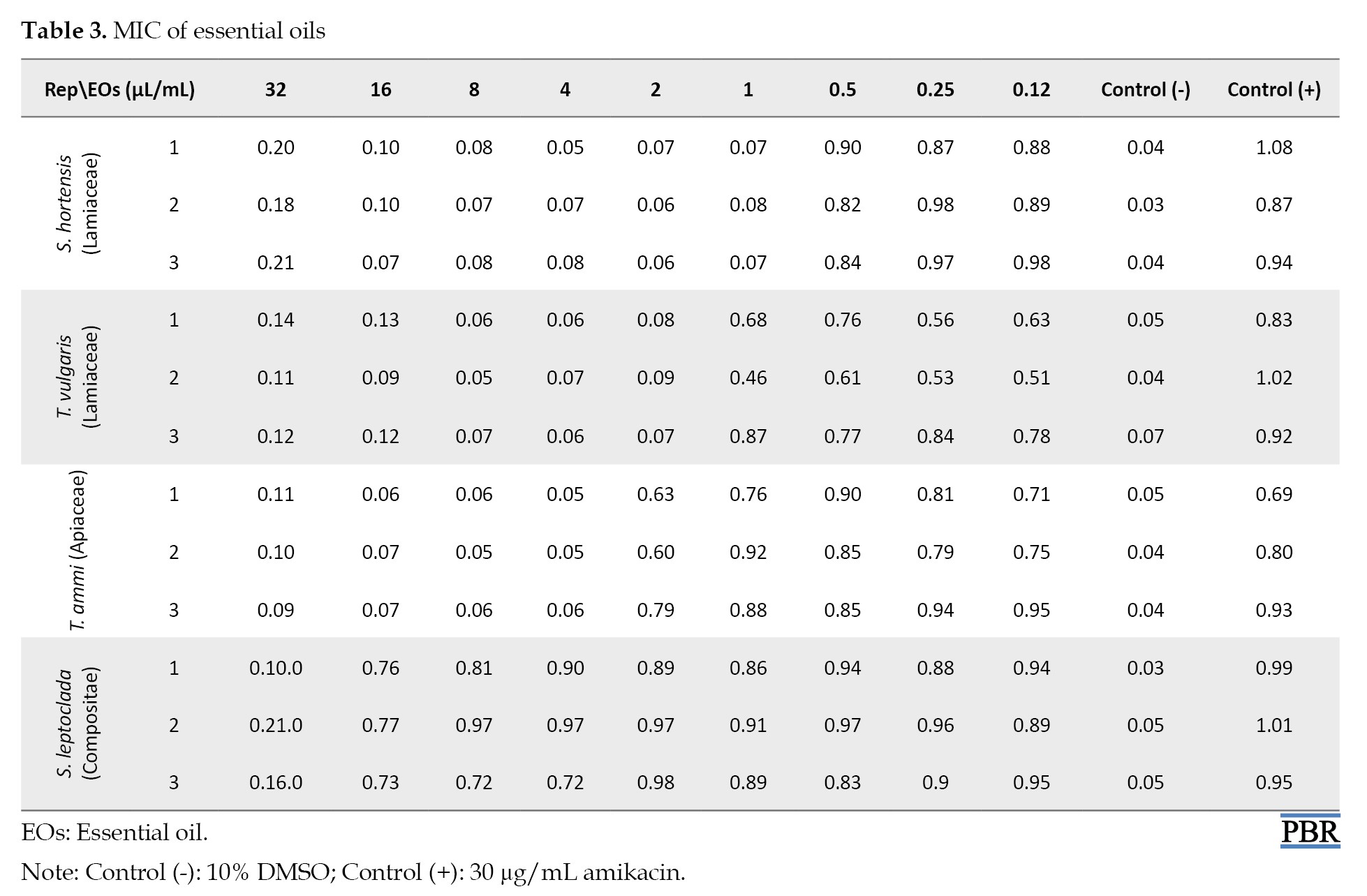
The MIC values for the 4 essential oils ranged from 1 µL/mL for S. hortensis, 2 µL/mL for T. vulgaris, 4 µL/mL for T. ammi, and 32 µL/mL for S. leptoclada. Slight increases in absorption coefficients were observed at higher essential oils concentrations (16 and 32 µL/mL for S. hortensis, T. ammi, and T. vulgaris, and 64 µL/mL for S. leptoclada), likely due to concentration-dependent effects.
The MBC results indicated that T. vulgaris and S. hortensis could inhibit B. gladioli at 2 µL/mL, with S. hortensis exhibiting a stronger inhibitory effect (Table 4).

The largest discrepancy between MIC and MBC was observed for T. ammi, which inhibited bacterial growth at 4 µL/mL but required 16 µL/mL to exert bactericidal activity.
Discussion
The antibacterial activity of plant essential oils is primarily attributed to their diverse bioactive constituents, particularly phenolic compounds and monoterpenes. Compounds such as carvacrol, thymol, borneol, limonene, linalool, terpinen-4-ol, and (E)-nerolidol have been widely reported to exhibit strong antimicrobial properties. These constituents exert their effects through multiple mechanisms, including disruption of bacterial cell membranes, increased membrane permeability, and interference with essential cellular processes, ultimately resulting in the inhibition of bacterial growth or cell death.
Previous studies have demonstrated notable antibacterial activity for carvacrol and thymol [23], borneol and monoterpenes such as limonene and linalool [26], terpinen-4-ol [27], and (E)-nerolidol [28]. Thymol has been identified as the predominant compound in the essential oils of T. vulgaris and T. ammi [29, 30], which may account for their strong antibacterial activity observed in the present study. Similarly, terpinen-4-ol and (E)-nerolidol are among the major constituents reported in S. leptoclada essential oil [31]. In addition, carvacrol, a compound well known for its potent antimicrobial properties, has been identified as a major constituent of S. hortensis. The pronounced inhibitory activity of S. hortensis essential oil against B. gladioli may therefore be attributed to the presence of this phenolic compound.
The results of the MIC and MBC assays further confirmed the antibacterial potential of these essential oils. S. hortensis and T. vulgaris exhibited the lowest MIC and MBC values, indicating strong antibacterial activity against B. gladioli. In contrast, S. leptoclada showed comparatively weaker activity, which may be related to differences in the concentration or composition of its active constituents.
The variability in antibacterial activity among the tested essential oils may be attributed to differences in their chemical profiles, which are influenced by plant species, geographical origin, harvest stage, and extraction methods [32, 33].
Overall, the findings of this study demonstrate that certain medicinal plant essential oils, particularly S. hortensis and T. vulgaris, possess considerable antibacterial activity against B. gladioli. These results suggest that such essential oils may serve as potential natural antibacterial agents for the management of bacterial diseases in plants; however, further investigations under greenhouse and field conditions are required to confirm their practical applicability.
Conclusion
This study identified 4 essential oils with significant antibacterial activity against B. gladioli, with S hortensis demonstrating the strongest inhibitory effect comparable to the antibiotic Amikacin. MIC and MBC assays confirmed the potent bacteriostatic and bactericidal properties of these oils. These findings highlight the potential of S. hortensis, T. vulgaris, T. ammi, and S. leptoclada essential oils as natural, eco-friendly alternatives for controlling B. gladioli infections in saffron cultivation. Further research should focus on formulation development and field trials to evaluate practical applications.
Ethical Considerations
Compliance with ethical guidelines
There were no ethical considerations to be considered in this research.
Funding
This study was conducted as part of a research project approved by the Department of Plant Protection, Khorasan Razavi Agricultural and Natural Resources Research and Education Center (AREEO), Mashhad, Iran (Grant No.: 014-43-16-124-99042).
Authors' contributions
Methodology and supervision: Mahmoud Reza Karimi-Shahri; Data collection: Arash Honarmand, Samaneh Rahamouz-Haghighi, and Elaheh Taheri; Data analysis: Mahmoud Reza Karimi-Shahri; Investigation and writing: all authors.
Conflict of interest
The authors declared no conflict of interest.
Acknowledgments
The authors appreciate the supported fromKhorasan Razavi Agricultural and Natural Resources Research Center, Mashhad, Iran.
References
Crocus sativus L. (Saffron, known as ‘Red Gold’) is a perennial autumn flowering plant that belongs to the Iridacea family plants. The dried stigma of the saffron plant is the most expensive spice and has a critical role in non-oil exporting economy of Iran [1]. The genus Crocus (Iridaceae) currently includes 261 species worldwide [2], with 24 species recognized in Iran [3]. According to the agronomic, physiological and biological traits of C. sativus, it could exploit marginal land and can substitute applicable crops in low-input cropping systems for sustainable agriculture [4]. Two possible origin areas have been reported for saffron: The Mediterranean area (Greece) and the East, especially Turkey, Iran, and India [5]. Saffron is mainly cultivated in Iran, Afghanistan, India, Morocco, Italy, Spain, and Greece. Iran, with 90% of the global saffron production, is largest producer in the world with an average yield of 3.53 kg ha1 (108000 ha) in 2017 (Razavi Khorasan Province with 84738 ha is main area in Iran) [6].
The most important bacterial pathogens of saffron corms are Burkholderia gladioli pv. gladioli and Bacillus croci [7]. B. gladioli pv. gladioli cause soft rot of emerging leaves and shoots and spots on corms and leaves in saffron and reduced flowering by approximately 80% [8]. Pathovars of B. gladioli have various host plants like species of Crocus and Iris, and also cause grain rot and leaf-sheath browning in rice and soft rot in onion [9]. Phytopathogenic strains of B. gladioli were divided into two pathovars (gladioli and alliicola) based on plant host and nutrition differences [10]. Using biochemical and molecular methods for bacterial isolate identification, Karimi-Shari et al. reported the first account of B. gladioli in saffron corms from Khorasan Razavi fields, Iran [11].
Two partial genomes of B. gladioli strains have been submitted in GenBank (13B 16S ribosomal RNA gene, Accession number: OP183349 and 13A 16S-23S ribosomal RNA, Accession number: OP218019) in 2022. This bacterium in Iran causes severely reduce saffron yields each year. Infected plants showed early leaf yellowing and draying. On the corms, decaying signs on the sheaths while some newly formed sprouts had tissue burnings and browning were observed. Furthermore, a ring shape red brown discoloration on the root germination zone of some infected saffron corms were observed that gradually decayed and extended to the deep corm. According to responsible authorities (plant protection organization) of Iran, no pesticides are registered or recommended in any level for saffron cultivations (except for two herbicides) [12]. Considering Iran’s substantial saffron exports, which require pesticide-free products, developing alternative control methods is critical. Most essential oils are classified as generally recognized as safe. They consist of volatile secondary metabolites extracted from various plant parts and possess bioactive properties such as anti-inflammatory, antibacterial, preservative, and decontaminant effects. Some components like carvacrol, resorcylic acid, eugenol, cinnamaldehyde, trans-cinnamaldehyde, vanillin, and thymol mainly have antibacterial activity [13].
Among the plant families, Lamiaceae plants have most and effective spices with high level of essential oils. Satureja hortensis L. (Summer savory; Marze in Persian) and Thymus vulgaris L. belong to the Lamiaceae family. S. hortensis is an aromatic annual plant with cosmopolitan distribution that is cultivated across the world; it is traditionally used as a natural food preservative, spice, anti-inflammatory, antifungal and antibacterial agent [14]. T. vulgaris (Thyme; Avishan in Persian), is an evergreen perennial, woody plant and indigenous to the Mediterranean region, parts of Asia and Northern Africa. T. vulgaris is cultivated around the world and people have used it as a culinary and flavoring agent as well as an herbal medicine. T. vulgaris has antibiotic, antiseptic, and antifungal activities [15]. Sclerorhachis leptoclada Rech. (Compositae) (Mastar in Persian) is an aromatic perennial plant used as an herbal medicine (aerial parts); it is useful for blood purification, increasing lactation, headache, treating digestive disorders and body pains [16]. Trachyspermum ammi (L.) Sprague (Apiaceae) (Ajwain; Zeniyan in Persian) is an aromatic annual herb that originated in India, Middle East, Iran, Egypt and Afghanistan and is also cultivated in many countries as medicinal, culinary and for the food, flavoring and spices industries.
T. ammi has some biological activity consisting of antioxidant, antimicrobial, and antiviral properties [17]. T. ammi exhibits diverse biological activities, including antioxidant, antimicrobial, and antiviral properties. Its methanolic and ethanolic extracts and essential oil demonstrated maximum inhibitory activity against Staphylococcus aureus [18, 19]. According to the literature, there is one study concerning antibacterial effects of essential oils against B. gladioli, which examined the antibacterial effect of clover on Tremella fuciformis Berk. (1856) (Fungi: Tremellaceae) as the host of pathogen [20]. Other studies have focused on other species of Burkholderia, such as Burkholderia cepacia complex [21-23], and B. glumae [24]. This study aimed to screen essential oils from 25 medicinal plants for their potent antibacterial activity against B. gladioli, a bacterial pathogen that reduces saffron yields in Iran, promoting pesticide-free crop protection.
Materials and Methods
Plants materials
All plants have been collected from South and Razavi Khorasan, Iran, during spring and summer of 2022 (Table 1).
Plants species were identified by a Botanist (Khorasan Razavi Agricultural & Natural resources Research Center) and dried for 2-3 weeks at 4 °C in shade. Plant materials were ground into a fine powder by an electric grinder and preserved in brown and isolated glass and stored in 4 °C until use.
Essential oil extraction
To extract essential oils from plant material, the clevenger apparatus type was used via the hydro-distillation method, following the standard procedure of the European pharmacopoeia (European pharmacopoeia. 2004, France). Fifty grams of powdered plant material and 500 mL of distilled water were added to a Pyrex extraction flask. After 3 h, essential oils were extracted from the aqueous layer and sodium sulfate anhydrous (Na2SO4) was used to dehydrate the essential oils. Dehydrated essential oils were stored in brown and isolated glasses at 4 °C until use.
Microorganisms
B. gladioli pv. gladioli (strain code: 150) was obtained from the culture collection of Khorasan Razavi Agricultural & Natural Resources Research Center, Iran. Strain 150 was isolated from infected saffron corm that collected from Khorasan Razavi saffron Field. This strain was cultured on nutrient agar (NA) and nutrient broth (NB) at 28 °C.
The disk diffusion assay
The bacterial isolate was cultured in NB at 28 °C for 48 h. After incubation, a suspension with a concentration of 10⁸ CFU/mL was prepared using sterile distilled water. Subsequently, 100 μL of the suspension was evenly spread on the surface of NA using a sterilized glass inoculating loop. The antibacterial activity was evaluated using a modified disk diffusion assay [14]. The bacterial suspension was allowed to absorb on the NA for 10 min at room temperature. Five microliters of each essential oil was added to a paper disk (5 mm diameter- Whatman No.1) and placed in the center of the NA surface. Amikacin 30 µg disk and dimethyl sulfoxide 10% (DMSO) were used as positive and negative controls, respectively [25]. All treatments (3 replicates) were incubated at 26 °C for 48 h. The inhibition zone (mm) was measured using a caliper.
Minimum inhibitory concentration (MIC) and minimum bactericidal concentration (MBC)
For treatments with visible halos from disk diffusion assay, MIC was assessed via the modified microdilution protocol of Mihajilov-Krstev et al. [26]. Strain 150 was cultured in NB at 28 °C for 48 h. 1000 μL sterilized NB plus 10 μL DMSO were added to a sterile microtube (2 mL). Then, 32 μL of each essential oils were added to the microtube to obtain 32 µL/mL at first microtube and two-fold dilution was used to make 16, 8, 4, 2, 1, 0.5, 0.25 and 0.12 µL/mL concentrations. A total of 10 µL/mL of bacterial suspension (106 CFU/mL) was inoculated to each microtube and incubated on a shaker oven (300 rpm, 28 °C) for 48 h. After confirming bacterial growth (turbidity) in the control, 200 μL from each microtube was transferred to 96-well microplates, and MIC values were determined using an ELISA reader (model: ELx800; wavelength: 630 nm). One thousand microliters of sterilized NB plus 10 μL DMSO was considered as the negative control and 1000 μL NB plus 10 μL DMSO inoculated with 10 µL/mL of bacterial suspension (106 CFU/mL) was used as the positive control. To determine MBC, NA plates were streaked from each treatment showing no growth at the lowest essential oil concentration.
Results
The antibacterial activities of essential oils derived from 25 medicinal plants were evaluated against B. gladioli (strain code: 150). Among the tested essential oils, 4 exhibited significant in vitro antibacterial effects. These oils included S. hortensis and T. vulgaris from the Lamiaceae family, T. ammi from the Apiaceae family, and S. leptoclada from the Compositae family. The diameters of the inhibition zones produced by these effective essential oils are summarized in Table 2.
The negative control, 10% DMSO, did not produce any inhibition zones in the disk diffusion assay. S. hortensis essential oil generated the largest inhibition zone with an average diameter of 22.66 mm, comparable to the positive control Amikacin (30 µg) (P<0.05), which produced an average inhibition zone of 22.00 mm. The inhibition zone of T. vulgaris (20.33 mm) was comparable to that of S. hortensis, while T. ammi (17.66 mm) and S. leptoclada (10.66 mm) exhibited weaker effects. Spectrophotometric turbidity measurements indicated that absorption coefficients ranging from 0.70 to 1.00 corresponded to full bacterial growth (positive control: Nutrient broth (NB)+DMSO+bacteria), while values between 0.03 and 0.10 indicated inhibited growth (negative control: NB+DMSO) after 48 h at 28 °C. The MIC assay results confirmed the disk diffusion findings (Table 3).
The MIC values for the 4 essential oils ranged from 1 µL/mL for S. hortensis, 2 µL/mL for T. vulgaris, 4 µL/mL for T. ammi, and 32 µL/mL for S. leptoclada. Slight increases in absorption coefficients were observed at higher essential oils concentrations (16 and 32 µL/mL for S. hortensis, T. ammi, and T. vulgaris, and 64 µL/mL for S. leptoclada), likely due to concentration-dependent effects.
The MBC results indicated that T. vulgaris and S. hortensis could inhibit B. gladioli at 2 µL/mL, with S. hortensis exhibiting a stronger inhibitory effect (Table 4).
The largest discrepancy between MIC and MBC was observed for T. ammi, which inhibited bacterial growth at 4 µL/mL but required 16 µL/mL to exert bactericidal activity.
Discussion
The antibacterial activity of plant essential oils is primarily attributed to their diverse bioactive constituents, particularly phenolic compounds and monoterpenes. Compounds such as carvacrol, thymol, borneol, limonene, linalool, terpinen-4-ol, and (E)-nerolidol have been widely reported to exhibit strong antimicrobial properties. These constituents exert their effects through multiple mechanisms, including disruption of bacterial cell membranes, increased membrane permeability, and interference with essential cellular processes, ultimately resulting in the inhibition of bacterial growth or cell death.
Previous studies have demonstrated notable antibacterial activity for carvacrol and thymol [23], borneol and monoterpenes such as limonene and linalool [26], terpinen-4-ol [27], and (E)-nerolidol [28]. Thymol has been identified as the predominant compound in the essential oils of T. vulgaris and T. ammi [29, 30], which may account for their strong antibacterial activity observed in the present study. Similarly, terpinen-4-ol and (E)-nerolidol are among the major constituents reported in S. leptoclada essential oil [31]. In addition, carvacrol, a compound well known for its potent antimicrobial properties, has been identified as a major constituent of S. hortensis. The pronounced inhibitory activity of S. hortensis essential oil against B. gladioli may therefore be attributed to the presence of this phenolic compound.
The results of the MIC and MBC assays further confirmed the antibacterial potential of these essential oils. S. hortensis and T. vulgaris exhibited the lowest MIC and MBC values, indicating strong antibacterial activity against B. gladioli. In contrast, S. leptoclada showed comparatively weaker activity, which may be related to differences in the concentration or composition of its active constituents.
The variability in antibacterial activity among the tested essential oils may be attributed to differences in their chemical profiles, which are influenced by plant species, geographical origin, harvest stage, and extraction methods [32, 33].
Overall, the findings of this study demonstrate that certain medicinal plant essential oils, particularly S. hortensis and T. vulgaris, possess considerable antibacterial activity against B. gladioli. These results suggest that such essential oils may serve as potential natural antibacterial agents for the management of bacterial diseases in plants; however, further investigations under greenhouse and field conditions are required to confirm their practical applicability.
Conclusion
This study identified 4 essential oils with significant antibacterial activity against B. gladioli, with S hortensis demonstrating the strongest inhibitory effect comparable to the antibiotic Amikacin. MIC and MBC assays confirmed the potent bacteriostatic and bactericidal properties of these oils. These findings highlight the potential of S. hortensis, T. vulgaris, T. ammi, and S. leptoclada essential oils as natural, eco-friendly alternatives for controlling B. gladioli infections in saffron cultivation. Further research should focus on formulation development and field trials to evaluate practical applications.
Ethical Considerations
Compliance with ethical guidelines
There were no ethical considerations to be considered in this research.
Funding
This study was conducted as part of a research project approved by the Department of Plant Protection, Khorasan Razavi Agricultural and Natural Resources Research and Education Center (AREEO), Mashhad, Iran (Grant No.: 014-43-16-124-99042).
Authors' contributions
Methodology and supervision: Mahmoud Reza Karimi-Shahri; Data collection: Arash Honarmand, Samaneh Rahamouz-Haghighi, and Elaheh Taheri; Data analysis: Mahmoud Reza Karimi-Shahri; Investigation and writing: all authors.
Conflict of interest
The authors declared no conflict of interest.
Acknowledgments
The authors appreciate the supported fromKhorasan Razavi Agricultural and Natural Resources Research Center, Mashhad, Iran.
References
- Lachguer K, Boudadi I, Lachheb M, Beraouz I, El Merzougui S, Ben El Caid M, et al. Saffron (Crocus sativus L.) cultivation and properties: a review. Int J Hortic Sci Technol. 2025; 12(2):627-46. [Link]
- Rukšāns J, Janis J. The world of crocuses, the first supplement. Riga: The Latvian Academy of Sciences:; 2023.
- Dolatyari A, Tolyat Abolhasani M, Ardalani F, Rukšāns J. A taxonomic revision of the genus Crocus (Iridaceae) in Iran. Nord. J. Bot. 2024; 2024(3):e04270. [DOI:10.1111/njb.04270]
- Acharya BS, Ghale A, Hamido S, Zinati G, Bozzolo A, Archer L, et al. Saffron (Crocus sativus L.): The golden spice-management, challenges, and opportunities for sustainable production in the United States. J Agric Food Res. 2025; 101970. [DOI:10.1016/j.jafr.2025.101970]
- Kafi M, Kamili AN, Husaini AM, Ozturk M, Altay V. An expensive spice saffron (Crocus sativus L.): A case study from Kashmir, Iran, and Turkey. In: Ozturk M, Hakeem KR, Ashraf M, Sajid Aqeel Ahmad S, editors. Global perspectives on underutilized crops. Cham: Springer International Publishing; 2018. [DOI:10.1007/978-3-319-77776-4_4]
- Cardone L, Castronuovo D, Perniola M, Cicco N, Candido V. Saffron (Crocus sativus L.), the king of spices: An overview. Sci Hortic. 2020; 272:109560. [DOI:10.1016/j.scienta.2020.109560]
- Koocheki A, Khajeh-Hosseini M. Saffron: Science, technology and health. Cambridge: Woodhead Publishing Limited; 2019. [Link]
- Fiori M, Ligios V, Schiaffino A. Identification and characterization of Burkholderia isolates obtained from bacterial rot of saffron (Crocus sativus L.) grown in Italy. Phytopathol Mediterr. 2011; 50(3):450-61. [Link]
- Compant S, Nowak J, Coenye T, Clement C, Barka EA. Diversity and occurrence of Burkholderia spp. in the natural environment. FEMS Microbiol Rev. 2008; 32(4):607-26. [DOI:10.1111/j.1574-6976.2008.00113.x] [PMID]
- Stoyanova M, Hristova P, Petrov N, Moncheva P, Bogatzevska N. Method for differentiating Burkholderia gladioli pathovars. Sci Technol. 2011; 1(6):15-9. [Link]
- Karimi Shahri MR, Mostafazadeh S, Yardehnavi F, Sedaghati N, Zarehhosseini H. [Molecular detection of Burkholderia gladioli in saffron fields of Khorasan Razavi Province (Persian)]. Paper presented at: 4th International and 16th Iranian National Genetics Congress; 2020 April 15; Tehran, Iran. [Link]
- Mahdavi V, Eslami Z, Golmohammadi G, Tajdar-Oranj B, Keikavousi Behbahan A, Mousavi Khaneghah A. Simultaneous determination of multiple pesticide residues in Iranian saffron: A probabilistic health risk assessment. J Food Compos Anal. 2021; 100:103915. [DOI:10.1016/j.jfca.2021.103915]
- Cho TJ, Park SM, Yu H, Seo GH, Kim HW, Kim SA, Rhee MS. Recent advances in the application of antibacterial complexes using essential oils. Molecules. 2020; 25(7):1752. [DOI:10.3390/molecules25071752] [PMID]
- Mihajilov-Krstev T, Radnović D, Kitić D, Zlatković B, Ristić M, Branković S. Chemical composition and antimicrobial activity of Satureja hortensis L. essential oil. Open Life Sci. 2009; 4(3):411-6. [DOI:10.2478/s11535-009-0027-z]
- Kuete V. Thymus vulgaris. In: Kuete V, editor. Medicinal spices and vegetables from Africa: Therapeutic potential against metabolic, inflammatory, infectious and systemic diseases. Cambridge: Academic Press; 2017. [DOI:10.1016/B978-0-12-809286-6.00028-5]
- Mohammadi T, Pirani A, Vaezi J, Moazzeni H. A contribution to ethnobotany and review of phytochemistry and biological activities of the Iranian local endemic species Sclerorhachis leptoclada Rech. f. Ethnobot Res Appl. 2020; 20:1-18. [DOI:10.32859/era.20.45.1-18]
- Gandomi H, Abbaszadeh S, Jebelli Javan A, Sharifzadeh A. Chemical constituents, antimicrobial and antioxidative effects of Trachyspermum ammi essential oil. J Food Process Preserv. 2014; 38(4):1690-5. [DOI:10.1111/jfpp.12131]
- Rahamouz HS, Asadi MH, Baghizadeh A. Antiproliferative and antibacterial properties of ethanolic extract and essential oil of Trachyspermum ammi and Foeniculum vulgare seeds on gastric cancer, Artemia salina larvae and pathogenic bacteria. Ethno Pharm Product. 2021; 2(2):42-50. [Link]
- Rahamouz-Haghighi S, Asadi MH, Gharari Z, Sharafi A. Foeniculum vulgare and Trachyspermum ammi seed ethanolic extracts: Cytotoxicity assay, in vitro toxicity on Artemia salina larvae, biocompatibility and antibacterial activity. Future Nat Prod. 2022; 8(1):15-22. [DOI:10.34172/fnp.2022.04]
- Wang H, Ma Y, Liu L, Liu Y, Niu N. Incorporation of clove essential oil nanoemulsion in chitosan coating to control Burkholderia gladioli and improve postharvest quality of fresh Tremella fuciformis. LWT. 2022; 170:114059. [DOI:10.1016/j.lwt.2022.114059]
- Maida I, Lo Nostro A, Pesavento G, Barnabei M, Calonico C, Perrin E, Fani R. Exploring the anti-Burkholderia cepacian complex activity of essential oils: A preliminary analysis. Evid Based Complement Alternat Med. 2014; 2014:621919. [DOI:10.1155/2014/573518] [PMID]
- Perrin E, Maggini V, Maida I, Gallo E, Lombardo K, Madarena MP, et al. Antimicrobial activity of six essential oils against Burkholderia cepacian complex: Insights into mechanism(s) of action. Future Microbiol. 2018; 13(1):59-67. [DOI:10.2217/fmb-2017-0121] [PMID]
- Vasinauskiene M, Radusiene J, Zitikaite I, Surviliene E. Antibacterial activities of essential oils from aromatic and medicinal plants against growth of phytopathogenic bacteria. Agron Res. 2006; 4:437-40. [Link]
- Gunasena MT, Rafi A, Mohd Zobir SA, Hussein MZ, Ali A, Kutawa AB, et al. Phytochemicals profiling, antimicrobial activity and mechanism of action of essential oil extracted from ginger (Zingiber officinale Roscoe cv. Bentong) against Burkholderia glumae causative agent of bacterial panicle blight disease of rice. Plants. 2022; 11(11):1466. [DOI:10.3390/plants11111466] [PMID]
- El-Said H, Ashgar SS, Bader A, AlQathama A, Halwani M, Ascrizzi R, et al. Essential oil analysis and antimicrobial evaluation of three aromatic plant species growing in Saudi Arabia. Molecules. 2021; 26(4):959. [DOI:10.3390/molecules26040959] [PMID]
- Mihajilov-Krstev T, Radnović D, Kitić D. Antimicrobial activity of Satureja L. essential oils against phytopathogenic bacteria Erwinia amylovora. Biologica Nyssana. 2010; 1(1-2):95-8. [Link]
- Cordeiro L, Pedro F, Helivaldo S, Sousa A, Andrade-Júnior F, et al. Terpinen-4-ol as an antibacterial and antibiofilm agent against Staphylococcus aureus. Int J Mol Sci. 2020; 21(12):4531. [DOI:10.3390/ijms21124531] [PMID]
- Kiryu M, Hamanaka M, Yoshitomi K, Mochizuki S, Akimitsu K, Gomi K. Rice terpene synthase 18 (OsTPS18) encodes a sesquiterpene synthase that produces an antibacterial (E)-nerolidol against a bacterial pathogen of rice. J Gen Plant Pathol. 2018; 84:221-9. [DOI:10.1007/s10327-018-0774-7]
- Karami OR, Khodaverdi M, Ali-Akabri F. Antibacterial effect of effective compounds of Satureja hortensis and Thymus vulgaris essential oils against Erwinia amylovora. J Agric Sci Technol. 2010; 12:35-45. [Link]
- Bairwa R, Sodha RS, Rajawat BS. Trachyspermum ammi. Phcog Rev. 2012; 6:56-61. [DOI:10.4103/0973-7847.95871] [PMID]
- Sonboli A, Mirjalili MH, Hadian H, Yousefzadi M. The biological activity and composition of the essential oil of Sclerorhachis leptoclada (Asteraceae-Anthemideae) from Iran. Iran J Pharm Res. 2014; 13(3):1097-102. [PMID]
- Radi M, Eddardar Z, Drioiche A, Remok F, Hosen ME, Zibouh K, et al. Comparative study of the chemical composition, antioxidant, and antimicrobial activity of the essential oils extracted from Lavandula abrialis and Lavandula stoechas: in vitro and in silico analysis. Front Chem. 2024;12:1353385. [DOI:10.3389/fchem.2024.1353385] [PMID]
- Rahamouz-Haghighi S, Yazdinezhad A, Bagheri Kh, Sharafi A. Volatile constituents and toxicity of essential oils extracted from aerial parts of Plantago lanceolata and Plantago major growing in Iran. PBR. 2022;8(3):205-24. [DOI:10.18502/pbr.v8i3.11035]
Type of Study: Original Research |
Subject:
Natural products
| Rights and permissions | |
 |
This work is licensed under a Creative Commons Attribution-NonCommercial 4.0 International License. |


This is an open access article distributed under the terms of the Creative Commons Attribution License (CC-By-NC), which permits use, distribution, and reproduction in any medium, provided the original work is properly cited and is not used for commercial purposes.
Contact Information