

Volume 12, Issue 2 (2026)
Pharm Biomed Res 2026, 12(2): 99-108 |
Back to browse issues page



Download citation:
BibTeX | RIS | EndNote | Medlars | ProCite | Reference Manager | RefWorks
Send citation to:


BibTeX | RIS | EndNote | Medlars | ProCite | Reference Manager | RefWorks
Send citation to:
Sadrzadeh-Afshar M, Moghtaderi-Esfahani E, Forouzani G. Comparative Antimicrobial Effects of Lemon Verbena Extracts and Chlorhexidine on Cariogenic Bacteria. Pharm Biomed Res 2026; 12 (2) :99-108
URL: http://pbr.mazums.ac.ir/article-1-654-en.html
URL: http://pbr.mazums.ac.ir/article-1-654-en.html
Comparative Antimicrobial Effects of Lemon Verbena Extracts and Chlorhexidine on Cariogenic Bacteria


1- Department of Oral and Maxillofacial Medicine, Faculty of Dentistry, Aja University of Medical Sciences, Tehran, Iran.
2- Department of Endodontics, Faculty of Dentistry, Shahed University of Medical Sciences, Tehran, Iran.
3- Department of Oral and Maxillofacial Medicine, School of Dentistry, Shahid Beheshti University of Medical Sciences, Tehran, Iran.
2- Department of Endodontics, Faculty of Dentistry, Shahed University of Medical Sciences, Tehran, Iran.
3- Department of Oral and Maxillofacial Medicine, School of Dentistry, Shahid Beheshti University of Medical Sciences, Tehran, Iran.
Keywords: Antimicrobial agents, Streptococcus mutans, Streptococcus sobrinus, Lactobacillus casei, Plant extracts
Full-Text [PDF 607 kb]
(191 Downloads)
| Abstract (HTML) (558 Views)
Full-Text: (102 Views)
Introduction
Dental caries is an infectious disease caused by the natural microflora bacteria of the mouth. According to reports from the World Health Organization (WHO), caries is the third non-communicable disease after cancer and cardiovascular diseases [1, 2]. Dental caries is caused by the transformation of a healthy oral microbiome into an acid-producing environment, accompanied by a decrease in microbial diversity in response to excessive consumption of sugar in the diet [3].
A large number of important extracellular polysaccharides that form the three-dimensional structure of dental plaque are synthesized by Streptococcus mutans [1]. Early colonization of S. mutans on primary (milk) incisors causes early and extensive caries attacks in deciduous teeth [4]. In a study, small plaque samples were collected from several white spots and pitted caries lesions on buccal surfaces. The proportion of S. mutans in samples collected from decayed areas was significantly higher than in healthy sites [5].
Caries incidence correlated significantly with S. mutans loads greater than 106 CFU/mL in saliva [6]. The relative contribution of S. mutans is likely to determine the cariogenic potential of the microbial community residing in pits and fissures [7]. The two species responsible for the initiation of human dental caries are S. mutans and Streptococcus sobrinus [8]. Lactate-producing species, such as S. sobrinus have also been observed in dental caries, but its prevalence is significantly lower than that of S. mutans, and in rare cases, S. sobrinus has been observed without S. mutans. Lactobacillus species have also been implicated in the secondary pathogenesis of caries.
Lactobacilli have been found in large numbers in both superficial and deep caries, although it is unlikely that they are involved in bacterial invasion of the unexposed dental pulp [9].
There are various methods to prevent caries, including mechanical removal of plaque and exposure to fluoride, sealants, restorations, calcium and phosphate compounds, probiotics, and anti-plaque chemicals [10].
Chlorhexidine is the first and most popular mouthwash and is considered the gold standard of anti-plaque treatments. Chlorhexidine gluconate solution (0.12%) is effective due to its cation chelation ability, which disrupts cell adhesion, cell membrane function, and the ability of S. mutans to absorb glucose, produce glucan, and carry out its metabolism, leading to a decrease in the number of S. mutans [7, 11]. However, it has side effects, such as altered oral taste, pain, burning sensation, tooth discoloration, and dry mouth.
Today, despite technological advances in the production of health products, there is increasing interest in using natural products and compounds due to the side effects of synthetic products, including systemic effects. Recent research aims to investigate these natural materials and their potential for extensive use. The antimicrobial properties of herbs, which do not affect the natural flora of the oral cavity, make them a suitable alternative to chemicals [8]. However, public awareness of natural products needs to be increased, and their use remains limited because research in this area has been scattered.
Aloysia citriodora belongs to the Verbenaceae family and has many medicinal properties. It is listed as a safe substance by the US Food and Drug Administration (FDA). Antimicrobial, insecticidal, neuropsychological, gastrointestinal, antioxidant, anti-inflammatory, metabolic, estrogenic, cardiovascular, anticancer effects have been attributed to this herb [12]. However, due to the lack of studies and evidence on the antibacterial effect of A. citriodora on caries-causing bacteria, including Lactobacillus casei, and the absence of research on different types of extracts of this herb, further tests were conducted in the present study.
Materials & Methods
This was a comparative-laboratory study.
Sampling process
The study population included S. mutans, S. sobrinus, and L. casei. The samples of each bacterium were divided into 5 main groups: 3 types of extracts (aqueous, hydroalcoholic, and hexane), 1 type of essential oil, and 1 type of chlorhexidine mouthwash (0.12%). In the three extract groups (aqueous, ethanol, and hexane), there were 8 different subgroups corresponding to concentrations of 250, 500, 1000, 2500, 5000, 10000, 20000, and 25000 µg/mL. The essential oil group had four concentrations: 5, 10, 50, and 100 μL. The chlorhexidine group had one concentration, namely 0.12%. This experiment was repeated 3 times, and the mean concentration was calculated. In total, the study population included 261 agar wells.
Procedure
A. citriodora was powdered using an electric mill (Attar Mill, Iran).
Scientific name: A. citriodora Palau
Family: Verbenaceae
Voucher number: PMP-2342
To prepare the aqueous extract, 1 kg of powdered herb was mixed with 7.5 liters of water and boiled on a gas stove for 3 hours. Then, this mixture was transferred to an Erlenmeyer flask through filter paper (Whatman No. 1). The obtained extract was placed in a rotary device (JFEG) at 70 °C with a rotation speed of 32 rpm to concentrate the extract and separate its solvent (i.e. water). Afterwards, the extract was spread on a tray to dry under a laboratory hood. The remaining dried extract was weighed and dissolved in 100 mL of sterilized distilled water, which was considered the aqueous extract of A. citriodora.
To prepare the hydroalcoholic extract, 1 kg of the powdered herb was soaked in 4 liters of 70% ethanol in a beaker for 10 days. Then, this mixture was transferred through filter paper (Whatman No. 1) to an Erlenmeyer flask. Again, the same process was repeated for 7 days and after the filtration process, it was transferred to an Erlenmeyer flask. The obtained extract was placed in a rotary machine at 70 °C with a rotation speed of 32 rpm to concentrate the extract and separate its solvent (i.e. 70% ethanol) from the extract. Then, it was placed in a bain-marie machine at 80 °C for 60 hours. Afterwards, the extract was spread on a tray to dry under a laboratory hood at ambient temperature. The remaining dried extract was weighed and dissolved in 100 mL of 5% dimethyl sulfoxide (DMSO) solution. This solution was considered the hydroalcoholic extract of A. citriodora.
To produce the hexane (non-polar) extract, 1 kg of powdered herb was soaked in 4 liters of pure hexane (100%) for 3 days. Then, this mixture was transferred to an Erlenmeyer flask through Whatman filter paper (No. 1). The obtained extract was placed in a rotary evaporator at 70°C and a rotation speed of 40 rpm to concentrate the extract and separate its solvent (i.e. 100% hexane) from the extract. Then it was placed in a bain-marie machine at 80 °C for 3 hours [13-16].
To produce the essential oil, 100 grams of the ground herb was dissolved in 500 cc of water, and the essential oil was extracted by a Cloninger machine (Scifinetech - Korea). This process was repeated 10 times until the required essential oil concentration was obtained. The standard strains of S. mutans (ATCC 35668), S. sobrinus (ATCC 27607), and L. casei (ATCC 39392) were prepared from nano rad medical laboratory [14, 17].
Agar well diffusion assay
The bacterial susceptibility to the solutions was measured using the agar well diffusion assay. For this purpose, a 0.5 McFarland suspension (1.5×10⁸) was prepared from the studied bacteria in a tube containing physiological serum, and then cultured on a Mueller Hinton agar plate (Merck-Germany). Then, a punch was created on the plate surface by a sterile punch device, and 100 μL of the tested samples of the aforementioned concentrations were loaded into the wells. Each sample was analyzed three times in the study. Finally, the plates were incubated at 37 °C for 24 hours. Afterwards, the diameter of the zone of inhibition (ZOI) was measured and recorded in millimeters [18].
Minimum inhibitory concentration (MIC) test
The MIC was determined by the broth microdilution method using a 96-well microplate. First, 100 μL of Mueller Hinton Broth was added to all wells of the microplate. Then, different concentrations of the test materials were prepared in the wells by the serial dilution method. Finally, 100 μL of bacterial suspension (106 CFU/mL) was added to each well. To ensure the accuracy of the test, positive controls (culture medium and solvent) and negative controls (culture medium, solvent, and bacteria) were also included. Then, the plates were incubated at 37 °C for 24 hours. Afterwards, the wells were examined for bacterial growth or no growth. The lowest concentration of the substance that inhibited the growth of the microorganism was reported as the MIC.
Data analysis method
The collected data were coded and entered into SPSS software, version 26 (IBM Corp., USA). Data were reported as Mean±SEM. To compare the ZOI diameters among different mouthwashes, the Kruskal-Wallis test was used. A P<0.05 was considered statistically significant.
Results
In this comparative laboratory study, the antibacterial effect of aqueous, hydroalcoholic, and hexane extracts and essential oil of A. citriodora and chlorhexidine mouthwash on S. mutans, S. sobrinus, and L. casei were investigated.
No ZOI was formed in the aqueous extract up to 2.5 mg/mL, but a 10.67-mm ZOI was observed at a concentration of 5 mg/mL, and the ZOI diameter reached 13.67 mL at the maximum studied concentration (25 mg/mL) mL). No ZOI was formed at hydroalcoholic extract concentrations up to 0.5 mg/mL, but an 11-mm ZOI was observed at 5 mg/mL, and the ZOI diameter reached 14.67 mm at the maximum studied concentration (25 mg/mL).
An inhibition zone was also formed in the hexane extract up to a concentration of 10 mg/mL, with a 13.33-mm ZOI observed at the last two concentrations (20 and 25 mg/mL). Also, a 15.33-mm ZOI was formed at the lowest essential oil concentration (5 μL), and the ZOI diameter increased to 37.67 mm at the maximum concentration (100 μL).
Finally, a 29.67-mm ZOI was formed when 0.12% chlorhexidine was applied. Therefore, according to the average results obtained at different concentrations, the strength of the antibacterial effect was as follows:
Essential oil > Chlorhexidine > Hydroalcoholic extract > Aqueous extract > Hexane extract
A 10.33-mm ZOI was formed with the aqueous extract only at the highest concentration (25 mg/mL). The ZOI diameter was about 11 mm only at the last two concentrations of the hydroalcoholic extract. No ZOI was observed at any concentration of the hexane extract. The ZOI diameter was 25.33 mm and 69.67 mm in the essential oil at the lowest (5 μL) and highest (100 μL) concentrations, respectively. Finally, a 33.35-mm ZOI was formed with 0.12% chlorhexidine.
Therefore, according to the average results obtained at different concentrations, the strength of the antibacterial effect was as follows:
Essential oil > chlorhexidine > hydroalcoholic extract > aqueous extract > hexane extract =0
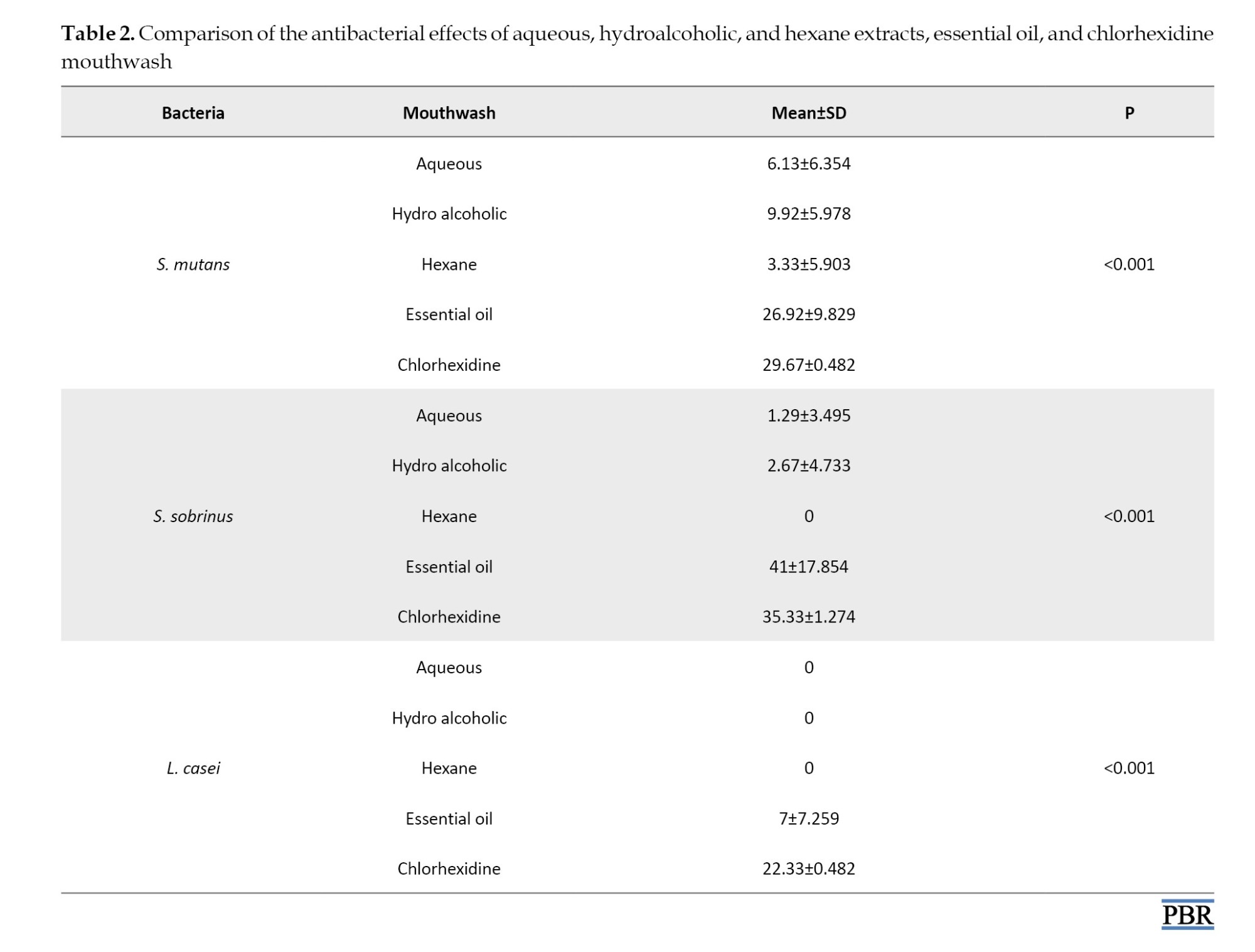
No ZOI was formed at any concentration of the aqueous, hydroalcoholic, or hexane extracts. No ZOI was observed in the essential oil up to 10 μL concentration, but it reached 15.67 mm at the highest concentration. A 22.33-mm ZOI was formed with 0.12% chlorhexidine. Therefore, according to the average results obtained at different concentrations, the strength of the antibacterial effect was as follows (Table 1):
Chlorhexidine > essential oil > hydroalcoholic extract = aqueous extract = hexane extract
The results showed that the highest susceptibility was related to chlorhexidine in S. mutans and L. casei and essential oil in S. sobrinus.
In all groups with different concentrations, there was a significant difference between different extracts, essential oils, and mouthwash (P>0.05) (Table 2).
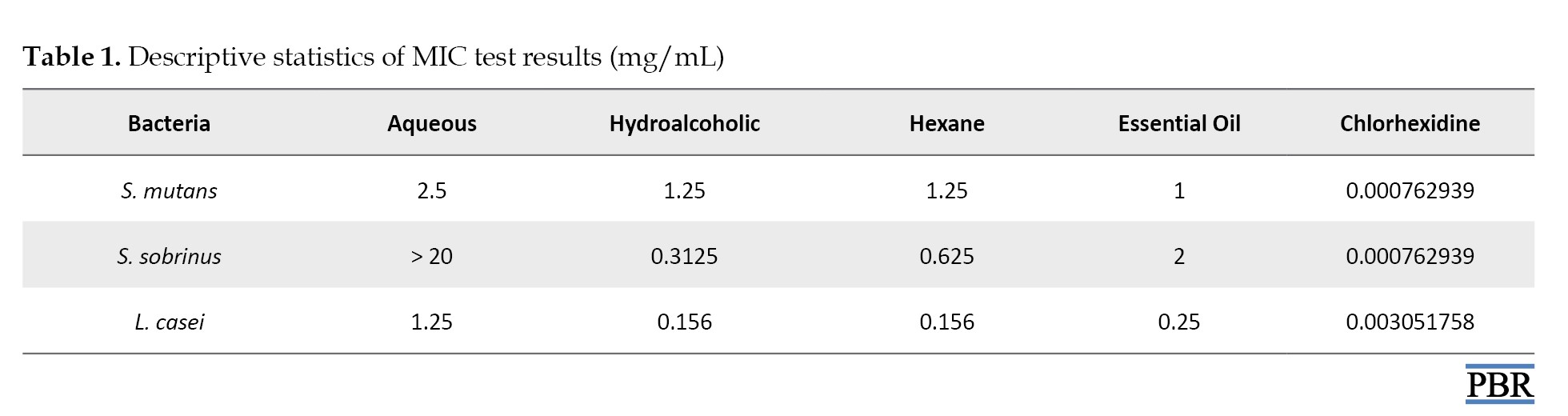
Growth inhibitory concentrations (MIC) of extracts, essential oils, and chlorhexidine: The highest MIC effect against S. mutans was as follows:
Chlorhexidine > essential oil > hydroalcoholic extract = hexane extract > aqueous extract
The highest MIC effect against S. sobrinus was as follows:
Chlorhexidine > hydroalcoholic extract > hexane extract > essential oil > aqueous extract
The highest MIC effect against L. casei was as follows:
Chlorhexidine > hydroalcoholic extract = hexane extract > essential oil > aqueous extract
Discussion
Despite the progress made in public policies so far, dental caries is the most common and costly infectious oral disease worldwide [13], which represents a global public health problem that must be managed by dental professionals. Chemical plaque control is one of the methods used. The main chemical agents currently available are fluoride, chlorhexidine, triclosan, cetylpyridinium chloride, and natural products [14].
In this regard, natural products (herbal extracts, essential oils, isolated compounds, and marine products) have been proposed as new therapeutic agents against dental caries in order to minimize the adverse effects of synthetic materials (e.g. altered taste, mucosal scaling, and tooth discoloration) and to provide effective and safe alternatives for caries control.
Examples of these natural products include propolis, black and green tea, cocoa bean shells, oat shells, blueberries and crustacean shells, and several others [15].
The diverse chemical structures of essential oils include two groups with distinct biosynthetic origins: Terpenes (monoterpenes and sesquiterpenes), terpenoids (isoprenoids) and another group of aliphatic and aromatic compounds (such as aldehydes, phenols, etc.), all of which are characterized by low molecular weight [16].
Monoterpenes are the main compounds found in essential oils and have been shown to exhibit strong antibacterial activity against caries-causing bacteria.
The bacteria studied in this research were among the oral microbial flora and play a role in the occurrence of oral and dental diseases. S. mutans is the most important caries-causing bacterium, which is associated with the onset of caries. Some researchers consider the presence of S. mutans to predict the occurrence of caries [17].
Therefore, the purpose of the present study was to investigate the antibacterial effect of aqueous, hydroalcoholic, and hexane extracts, as well as the essential oil of A. citriodora on caries-causing bacteria (S. mutans, S. sobrinus, and L. casei), and to compare these effects with the standard 0.12% chlorhexidine mouthwash.
In this study, the agar well diffusion assay and measurement of the ZOI were used to determine the susceptibility to chlorhexidine mouthwash, extracts, and essential oil of A. citriodora. Mueller Hinton Broth culture medium was used to determine the MIC of each extract, essential oil, and the mouthwash.
The results of the disc diffusion assay and ZOI showed that the most effective extracts against S. mutans were, in order, hydroalcoholic, aqueous, and hexane extracts. No antibacterial effect was observed at the lowest concentration (250 µg/mL) of the hydroalcoholic extract, but the antibacterial effect increased at higher concentrations. There was no antibacterial effect in the aqueous extract up to a concentration of 2500 µg/mL, but the antibacterial effect increased at higher concentrations.
There was no antibacterial effect in the hexane extract up to a concentration of 10,000 (µg/mL), but antibacterial effects were observed at concentrations of 20,000 and 25,000 µg/mL.
A. citriodora essential oil was effective against S. mutans at all tested concentrations. The highest ZOI diameter was 38 mm at 100 μL of essential oil, which was even larger than the ZOI diameter of chlorhexidine (30 mm).
In the case of S. sobrinus, no ZOI was formed at any concentration of the hexane extract.
A ZOI was also observed in the aqueous extract only at the highest concentration (25000 µg/mL). Antibacterial effects in the hydroalcoholic extract were observed only at concentrations of 20,000 and 25,000 µg/mL.
S. sobrinus was more resistant to A. citriodora extracts than S. mutans, but it was more susceptible to A. citriodora essential oil. A 70-mm ZOI was formed at 100 μL of essential oil, which was twice as large as the ZOI formed in S. mutans. Also, the ZOI diameter in the essential oil was 100% larger than that of the positive control (0.12% chlorhexidine mouthwashes). In In the case of L. casei, none of the aqueous, hydroalcoholic, or hexane extracts formed a ZOI. However, A. citriodora essential oil (50 and 100 μL) produced a 15-mm ZOI, which was slightly smaller than the ZOI formed by the chlorhexidine mouthwash.
S. mutans had the largest ZOI, indicating the highest susceptibility to A. citriodora extracts, while L. casei showed the highest resistance to these extracts. Also, S. sobrinus and L. casei showed the highest and lowest susceptibility, respectively, to A. citriodora essential oil.
In this study, MIC results showed that chlorhexidine mouthwash was the most effective against all bacteria.
The lowest MIC concentration in S. mutans, after chlorhexidine mouthwash, was observed in the essential oil, followed by hydroalcoholic, hexane, and aqueous extracts, respectively.
For S. sobrinus, the lowest MIC concentration was obtained with the hydroalcoholic extract, followed by the hexane extract, essential oil, and aqueous extract, respectively. In the case of L. casei, the lowest MIC concentration was observed with the hydroalcoholic extract, followed by the essential oil and aqueous extract, respectively.
The effects of various herbs on caries-causing bacteria have been investigated. In a review article, Freires et al. investigated the antibacterial effects of the essential oils of various herbs on caries-causing bacteria [14].
A. citriodora extract and essential oil have antibacterial effects on various bacteria. A. citriodora extract and essential oil have antibacterial effects on various bacteria.
Hosseini et al. investigated the antibacterial effect of A. citriodora and cloves on Bacillus cereus, Listeria monocytogenes, Staphylococcus aureus, Shigella dysenteriae, Pseudomonas aeruginosa, Salmonella typhimurium, and Escherichia coli. They identified S. dysenteriae as the most susceptible bacteria to A. citriodora essential oil [18].
In another study, Mirzaei et al. investigated the antibacterial effects of the A. citriodora. The results showed that the A. citriodora extract has significant antibacterial effects on Bacillus subtilis, P. aeruginosa, and E. coli [19].
In the study by Bahramsoltani et al. the essential oil obtained from the leaves of A. citriodora showed antibacterial activity against E. coli, S. aureus, and P. aeruginosa, with MIC values ranging from 2.84 to 8.37 mg/mL [12].
In a study, Jeradet et al. [20] stated that the A. citriodora essential oil collected from the Umm al-Fahm and Bogha al-Gharbi regions has the same antibacterial effect against methicillin-resistant S. aureus (MRSA), S. aureus, Klebsiella pneumonia, and Proteus vulgaris, while these essential oils were inactive against E. coli and P. aeruginosa [20].
In a study, Rojas et al. obtained A. citriodora essential oil by distillation and analyzed it using gas chromatography. A total of 22 components were identified. The main ingredients included geranial (27.3%), neral (22.5%), graniol (6.2%), bicyclogermacrene (5.2%), and nerol (4.9%). The antibacterial activity against clinical isolates of urinary tract and vaginal bacterial infections was evaluated by agar disk diffusion assay, and the results showed inhibition of the growth of all isolates of E. coli, Klebsiella ozane, Enterobacter, Proteus mirabilis, and S. aureus [21].
In a study, Tammar et al. investigated the antibacterial effect of A. citriodora extract on S. aureus, L. monocytogenes, Enterococcus faecalis, E. coli, P. aeruginosa, and Salmonella arizona. The ZOI diameter was strongly affected in S. aureus, L. monocytogenes, P. aeruginosa, and S. arizonae. On the other hand, there was no significant difference in the antibacterial activity of methanol extracts of the studied herb against E. coli. The highest antibacterial activity was observed against L. monocytogenes [22].
In the study by Kumar et al., the antibacterial activity of aqueous and organic A. citriodora extracts was studied against gram-positive (B. subtilis and S. aureus) and gram-negative (Klebsiella pneumoniae, E. coli and P. vulgaris) bacteria. They found that all bacterial strains were resistant to the aqueous extract, while the methanolic and ethanolic extracts showed moderate activity. Partial growth inhibition was observed with chloroform, diethyl ether, and chloroform-methanol extracts (1:3) against all these studied strains [23].
The literature review showed that the only study investigating the effect of A. citriodora extracts on caries-causing bacteria was conducted by Shafiei et al. where the effects of aqueous and hydroalcoholic extracts were compared to amoxicillin and chlorhexidine on caries-causing bacteria, and the results indicated no antibacterial effect [8].
However, in the present research, in addition to investigating aqueous and hydroalcoholic extracts, the effects of the hexane extract (for non-polar compounds) and essential oil were also investigated.
The lack of antibacterial effects in that study could be attributed to various reasons. The American bacterial strains were selected in the present study, whereas Persian strains and clinical samples isolated from dental caries of children admitted to the Pediatric Ward of the Faculty of Dentistry, Babol University of Medical Sciences (Babol, Iran) were used in Shafiei et al.’s study.
Other reasons include possible differences in the chemical composition of the extracts due to quantitative and qualitative variations resulting from distinct chemotypes, genetic factors, geographical origin, macro- and micronutrient elements in the soil, extraction location, extraction method, time of harvest, and so on [8].
Finally, it should be noted that controlling integrated biofilms is more difficult [24]. A possible explanation is that the resistance caused by biofilm formation is due to the presence of polysaccharides that cover the biofilm, protecting the microorganisms against external factors and making them more resistant [25].
Besides, the caries-causing biofilm consists of a multispecies microbial community, in which the predominance of different microorganisms changes as a function of the host factors, diet, and microbial interactions [24].
These aspects are not considered in most studies that evaluate only planktonic cultures or single-species biofilm cultures [25].
Conclusion
The results of the present study showed that aqueous, hydroalcoholic, and hexane extracts, as well as the essential oil of A. citriodora, have antibacterial effects against caries-causing bacteria.
In the case of S. mutans, the order of the ZOI diameter at the average concentrations of extracts and essential oils was as follows: Chlorhexidine > essential oil > hydroalcoholic > aqueous > hexane.
In the case of S. sobrinus, the order of the ZOI diameter at the average concentrations of extracts and essential oil was as follows: Essential oil > chlorhexidine > hydroalcoholic > aqueous > hexane.
In the case of S. mutans, the order of the ZOI diameter at the average concentrations of extracts and essential oils was as follows: Chlorhexidine > essential oil > hydroalcoholic = aqueous = hexane.
Chlorhexidine mouthwash showed stronger antibacterial effects than A. citriodora extracts and essential oil, except against S. sobrinus. If confirmed by future studies, A. citriodora extracts and essential oil could be used in mouthwashes or toothpastes to combat caries-causing bacteria.
The study’s strengths include testing all extract types and key cariogenic bacteria, while limited funding was a constraint that prevented the use of more precise methods, like E-test strips. Future research should examine the antibacterial activity of A. citriodora in biofilms, compare extraction methods, and clinically evaluate formulated mouthwashes for caries and periodontal indicators.
Ethical Considerations
Compliance with ethical guidelines
This study was approved by the Research Ethics Committee of Aja University of Medical Sciences, Tehran, Iran (Code: IR.AJAUMS.REC.1401.048).
Funding
This research did not receive any grant from funding agencies in the public, commercial, or non-profit sectors.
Authors' contributions
Conceptualization and supervision: Maryam-Sadat Sadrzadeh-Afshar; Methodology: Maryam-Sadat Sadrzadeh-Afshar and Ehsan Moghtaderi-Esfahani; Data collection: Ehsan Moghtaderi-Esfahani; Investigation and data analysis: Ehsan Moghtaderi-Esfahani and Gelareh Forouzani; Funding and writing the original draft: Ehsan Moghtaderi-Esfahani; Project administration, Review and editing: Gelareh Forouzani and Maryam-Sadat Sadrzadeh-Afsha.
Conflict of interest
The authors declared no conflicts of interest.
References
Dental caries is an infectious disease caused by the natural microflora bacteria of the mouth. According to reports from the World Health Organization (WHO), caries is the third non-communicable disease after cancer and cardiovascular diseases [1, 2]. Dental caries is caused by the transformation of a healthy oral microbiome into an acid-producing environment, accompanied by a decrease in microbial diversity in response to excessive consumption of sugar in the diet [3].
A large number of important extracellular polysaccharides that form the three-dimensional structure of dental plaque are synthesized by Streptococcus mutans [1]. Early colonization of S. mutans on primary (milk) incisors causes early and extensive caries attacks in deciduous teeth [4]. In a study, small plaque samples were collected from several white spots and pitted caries lesions on buccal surfaces. The proportion of S. mutans in samples collected from decayed areas was significantly higher than in healthy sites [5].
Caries incidence correlated significantly with S. mutans loads greater than 106 CFU/mL in saliva [6]. The relative contribution of S. mutans is likely to determine the cariogenic potential of the microbial community residing in pits and fissures [7]. The two species responsible for the initiation of human dental caries are S. mutans and Streptococcus sobrinus [8]. Lactate-producing species, such as S. sobrinus have also been observed in dental caries, but its prevalence is significantly lower than that of S. mutans, and in rare cases, S. sobrinus has been observed without S. mutans. Lactobacillus species have also been implicated in the secondary pathogenesis of caries.
Lactobacilli have been found in large numbers in both superficial and deep caries, although it is unlikely that they are involved in bacterial invasion of the unexposed dental pulp [9].
There are various methods to prevent caries, including mechanical removal of plaque and exposure to fluoride, sealants, restorations, calcium and phosphate compounds, probiotics, and anti-plaque chemicals [10].
Chlorhexidine is the first and most popular mouthwash and is considered the gold standard of anti-plaque treatments. Chlorhexidine gluconate solution (0.12%) is effective due to its cation chelation ability, which disrupts cell adhesion, cell membrane function, and the ability of S. mutans to absorb glucose, produce glucan, and carry out its metabolism, leading to a decrease in the number of S. mutans [7, 11]. However, it has side effects, such as altered oral taste, pain, burning sensation, tooth discoloration, and dry mouth.
Today, despite technological advances in the production of health products, there is increasing interest in using natural products and compounds due to the side effects of synthetic products, including systemic effects. Recent research aims to investigate these natural materials and their potential for extensive use. The antimicrobial properties of herbs, which do not affect the natural flora of the oral cavity, make them a suitable alternative to chemicals [8]. However, public awareness of natural products needs to be increased, and their use remains limited because research in this area has been scattered.
Aloysia citriodora belongs to the Verbenaceae family and has many medicinal properties. It is listed as a safe substance by the US Food and Drug Administration (FDA). Antimicrobial, insecticidal, neuropsychological, gastrointestinal, antioxidant, anti-inflammatory, metabolic, estrogenic, cardiovascular, anticancer effects have been attributed to this herb [12]. However, due to the lack of studies and evidence on the antibacterial effect of A. citriodora on caries-causing bacteria, including Lactobacillus casei, and the absence of research on different types of extracts of this herb, further tests were conducted in the present study.
Materials & Methods
This was a comparative-laboratory study.
Sampling process
The study population included S. mutans, S. sobrinus, and L. casei. The samples of each bacterium were divided into 5 main groups: 3 types of extracts (aqueous, hydroalcoholic, and hexane), 1 type of essential oil, and 1 type of chlorhexidine mouthwash (0.12%). In the three extract groups (aqueous, ethanol, and hexane), there were 8 different subgroups corresponding to concentrations of 250, 500, 1000, 2500, 5000, 10000, 20000, and 25000 µg/mL. The essential oil group had four concentrations: 5, 10, 50, and 100 μL. The chlorhexidine group had one concentration, namely 0.12%. This experiment was repeated 3 times, and the mean concentration was calculated. In total, the study population included 261 agar wells.
Procedure
A. citriodora was powdered using an electric mill (Attar Mill, Iran).
Scientific name: A. citriodora Palau
Family: Verbenaceae
Voucher number: PMP-2342
To prepare the aqueous extract, 1 kg of powdered herb was mixed with 7.5 liters of water and boiled on a gas stove for 3 hours. Then, this mixture was transferred to an Erlenmeyer flask through filter paper (Whatman No. 1). The obtained extract was placed in a rotary device (JFEG) at 70 °C with a rotation speed of 32 rpm to concentrate the extract and separate its solvent (i.e. water). Afterwards, the extract was spread on a tray to dry under a laboratory hood. The remaining dried extract was weighed and dissolved in 100 mL of sterilized distilled water, which was considered the aqueous extract of A. citriodora.
To prepare the hydroalcoholic extract, 1 kg of the powdered herb was soaked in 4 liters of 70% ethanol in a beaker for 10 days. Then, this mixture was transferred through filter paper (Whatman No. 1) to an Erlenmeyer flask. Again, the same process was repeated for 7 days and after the filtration process, it was transferred to an Erlenmeyer flask. The obtained extract was placed in a rotary machine at 70 °C with a rotation speed of 32 rpm to concentrate the extract and separate its solvent (i.e. 70% ethanol) from the extract. Then, it was placed in a bain-marie machine at 80 °C for 60 hours. Afterwards, the extract was spread on a tray to dry under a laboratory hood at ambient temperature. The remaining dried extract was weighed and dissolved in 100 mL of 5% dimethyl sulfoxide (DMSO) solution. This solution was considered the hydroalcoholic extract of A. citriodora.
To produce the hexane (non-polar) extract, 1 kg of powdered herb was soaked in 4 liters of pure hexane (100%) for 3 days. Then, this mixture was transferred to an Erlenmeyer flask through Whatman filter paper (No. 1). The obtained extract was placed in a rotary evaporator at 70°C and a rotation speed of 40 rpm to concentrate the extract and separate its solvent (i.e. 100% hexane) from the extract. Then it was placed in a bain-marie machine at 80 °C for 3 hours [13-16].
To produce the essential oil, 100 grams of the ground herb was dissolved in 500 cc of water, and the essential oil was extracted by a Cloninger machine (Scifinetech - Korea). This process was repeated 10 times until the required essential oil concentration was obtained. The standard strains of S. mutans (ATCC 35668), S. sobrinus (ATCC 27607), and L. casei (ATCC 39392) were prepared from nano rad medical laboratory [14, 17].
Agar well diffusion assay
The bacterial susceptibility to the solutions was measured using the agar well diffusion assay. For this purpose, a 0.5 McFarland suspension (1.5×10⁸) was prepared from the studied bacteria in a tube containing physiological serum, and then cultured on a Mueller Hinton agar plate (Merck-Germany). Then, a punch was created on the plate surface by a sterile punch device, and 100 μL of the tested samples of the aforementioned concentrations were loaded into the wells. Each sample was analyzed three times in the study. Finally, the plates were incubated at 37 °C for 24 hours. Afterwards, the diameter of the zone of inhibition (ZOI) was measured and recorded in millimeters [18].
Minimum inhibitory concentration (MIC) test
The MIC was determined by the broth microdilution method using a 96-well microplate. First, 100 μL of Mueller Hinton Broth was added to all wells of the microplate. Then, different concentrations of the test materials were prepared in the wells by the serial dilution method. Finally, 100 μL of bacterial suspension (106 CFU/mL) was added to each well. To ensure the accuracy of the test, positive controls (culture medium and solvent) and negative controls (culture medium, solvent, and bacteria) were also included. Then, the plates were incubated at 37 °C for 24 hours. Afterwards, the wells were examined for bacterial growth or no growth. The lowest concentration of the substance that inhibited the growth of the microorganism was reported as the MIC.
Data analysis method
The collected data were coded and entered into SPSS software, version 26 (IBM Corp., USA). Data were reported as Mean±SEM. To compare the ZOI diameters among different mouthwashes, the Kruskal-Wallis test was used. A P<0.05 was considered statistically significant.
Results
In this comparative laboratory study, the antibacterial effect of aqueous, hydroalcoholic, and hexane extracts and essential oil of A. citriodora and chlorhexidine mouthwash on S. mutans, S. sobrinus, and L. casei were investigated.
No ZOI was formed in the aqueous extract up to 2.5 mg/mL, but a 10.67-mm ZOI was observed at a concentration of 5 mg/mL, and the ZOI diameter reached 13.67 mL at the maximum studied concentration (25 mg/mL) mL). No ZOI was formed at hydroalcoholic extract concentrations up to 0.5 mg/mL, but an 11-mm ZOI was observed at 5 mg/mL, and the ZOI diameter reached 14.67 mm at the maximum studied concentration (25 mg/mL).
An inhibition zone was also formed in the hexane extract up to a concentration of 10 mg/mL, with a 13.33-mm ZOI observed at the last two concentrations (20 and 25 mg/mL). Also, a 15.33-mm ZOI was formed at the lowest essential oil concentration (5 μL), and the ZOI diameter increased to 37.67 mm at the maximum concentration (100 μL).
Finally, a 29.67-mm ZOI was formed when 0.12% chlorhexidine was applied. Therefore, according to the average results obtained at different concentrations, the strength of the antibacterial effect was as follows:
Essential oil > Chlorhexidine > Hydroalcoholic extract > Aqueous extract > Hexane extract
A 10.33-mm ZOI was formed with the aqueous extract only at the highest concentration (25 mg/mL). The ZOI diameter was about 11 mm only at the last two concentrations of the hydroalcoholic extract. No ZOI was observed at any concentration of the hexane extract. The ZOI diameter was 25.33 mm and 69.67 mm in the essential oil at the lowest (5 μL) and highest (100 μL) concentrations, respectively. Finally, a 33.35-mm ZOI was formed with 0.12% chlorhexidine.
Therefore, according to the average results obtained at different concentrations, the strength of the antibacterial effect was as follows:
Essential oil > chlorhexidine > hydroalcoholic extract > aqueous extract > hexane extract =0
No ZOI was formed at any concentration of the aqueous, hydroalcoholic, or hexane extracts. No ZOI was observed in the essential oil up to 10 μL concentration, but it reached 15.67 mm at the highest concentration. A 22.33-mm ZOI was formed with 0.12% chlorhexidine. Therefore, according to the average results obtained at different concentrations, the strength of the antibacterial effect was as follows (Table 1):
Chlorhexidine > essential oil > hydroalcoholic extract = aqueous extract = hexane extract
The results showed that the highest susceptibility was related to chlorhexidine in S. mutans and L. casei and essential oil in S. sobrinus.
In all groups with different concentrations, there was a significant difference between different extracts, essential oils, and mouthwash (P>0.05) (Table 2).
Growth inhibitory concentrations (MIC) of extracts, essential oils, and chlorhexidine: The highest MIC effect against S. mutans was as follows:
Chlorhexidine > essential oil > hydroalcoholic extract = hexane extract > aqueous extract
The highest MIC effect against S. sobrinus was as follows:
Chlorhexidine > hydroalcoholic extract > hexane extract > essential oil > aqueous extract
The highest MIC effect against L. casei was as follows:
Chlorhexidine > hydroalcoholic extract = hexane extract > essential oil > aqueous extract
Discussion
Despite the progress made in public policies so far, dental caries is the most common and costly infectious oral disease worldwide [13], which represents a global public health problem that must be managed by dental professionals. Chemical plaque control is one of the methods used. The main chemical agents currently available are fluoride, chlorhexidine, triclosan, cetylpyridinium chloride, and natural products [14].
In this regard, natural products (herbal extracts, essential oils, isolated compounds, and marine products) have been proposed as new therapeutic agents against dental caries in order to minimize the adverse effects of synthetic materials (e.g. altered taste, mucosal scaling, and tooth discoloration) and to provide effective and safe alternatives for caries control.
Examples of these natural products include propolis, black and green tea, cocoa bean shells, oat shells, blueberries and crustacean shells, and several others [15].
The diverse chemical structures of essential oils include two groups with distinct biosynthetic origins: Terpenes (monoterpenes and sesquiterpenes), terpenoids (isoprenoids) and another group of aliphatic and aromatic compounds (such as aldehydes, phenols, etc.), all of which are characterized by low molecular weight [16].
Monoterpenes are the main compounds found in essential oils and have been shown to exhibit strong antibacterial activity against caries-causing bacteria.
The bacteria studied in this research were among the oral microbial flora and play a role in the occurrence of oral and dental diseases. S. mutans is the most important caries-causing bacterium, which is associated with the onset of caries. Some researchers consider the presence of S. mutans to predict the occurrence of caries [17].
Therefore, the purpose of the present study was to investigate the antibacterial effect of aqueous, hydroalcoholic, and hexane extracts, as well as the essential oil of A. citriodora on caries-causing bacteria (S. mutans, S. sobrinus, and L. casei), and to compare these effects with the standard 0.12% chlorhexidine mouthwash.
In this study, the agar well diffusion assay and measurement of the ZOI were used to determine the susceptibility to chlorhexidine mouthwash, extracts, and essential oil of A. citriodora. Mueller Hinton Broth culture medium was used to determine the MIC of each extract, essential oil, and the mouthwash.
The results of the disc diffusion assay and ZOI showed that the most effective extracts against S. mutans were, in order, hydroalcoholic, aqueous, and hexane extracts. No antibacterial effect was observed at the lowest concentration (250 µg/mL) of the hydroalcoholic extract, but the antibacterial effect increased at higher concentrations. There was no antibacterial effect in the aqueous extract up to a concentration of 2500 µg/mL, but the antibacterial effect increased at higher concentrations.
There was no antibacterial effect in the hexane extract up to a concentration of 10,000 (µg/mL), but antibacterial effects were observed at concentrations of 20,000 and 25,000 µg/mL.
A. citriodora essential oil was effective against S. mutans at all tested concentrations. The highest ZOI diameter was 38 mm at 100 μL of essential oil, which was even larger than the ZOI diameter of chlorhexidine (30 mm).
In the case of S. sobrinus, no ZOI was formed at any concentration of the hexane extract.
A ZOI was also observed in the aqueous extract only at the highest concentration (25000 µg/mL). Antibacterial effects in the hydroalcoholic extract were observed only at concentrations of 20,000 and 25,000 µg/mL.
S. sobrinus was more resistant to A. citriodora extracts than S. mutans, but it was more susceptible to A. citriodora essential oil. A 70-mm ZOI was formed at 100 μL of essential oil, which was twice as large as the ZOI formed in S. mutans. Also, the ZOI diameter in the essential oil was 100% larger than that of the positive control (0.12% chlorhexidine mouthwashes). In In the case of L. casei, none of the aqueous, hydroalcoholic, or hexane extracts formed a ZOI. However, A. citriodora essential oil (50 and 100 μL) produced a 15-mm ZOI, which was slightly smaller than the ZOI formed by the chlorhexidine mouthwash.
S. mutans had the largest ZOI, indicating the highest susceptibility to A. citriodora extracts, while L. casei showed the highest resistance to these extracts. Also, S. sobrinus and L. casei showed the highest and lowest susceptibility, respectively, to A. citriodora essential oil.
In this study, MIC results showed that chlorhexidine mouthwash was the most effective against all bacteria.
The lowest MIC concentration in S. mutans, after chlorhexidine mouthwash, was observed in the essential oil, followed by hydroalcoholic, hexane, and aqueous extracts, respectively.
For S. sobrinus, the lowest MIC concentration was obtained with the hydroalcoholic extract, followed by the hexane extract, essential oil, and aqueous extract, respectively. In the case of L. casei, the lowest MIC concentration was observed with the hydroalcoholic extract, followed by the essential oil and aqueous extract, respectively.
The effects of various herbs on caries-causing bacteria have been investigated. In a review article, Freires et al. investigated the antibacterial effects of the essential oils of various herbs on caries-causing bacteria [14].
A. citriodora extract and essential oil have antibacterial effects on various bacteria. A. citriodora extract and essential oil have antibacterial effects on various bacteria.
Hosseini et al. investigated the antibacterial effect of A. citriodora and cloves on Bacillus cereus, Listeria monocytogenes, Staphylococcus aureus, Shigella dysenteriae, Pseudomonas aeruginosa, Salmonella typhimurium, and Escherichia coli. They identified S. dysenteriae as the most susceptible bacteria to A. citriodora essential oil [18].
In another study, Mirzaei et al. investigated the antibacterial effects of the A. citriodora. The results showed that the A. citriodora extract has significant antibacterial effects on Bacillus subtilis, P. aeruginosa, and E. coli [19].
In the study by Bahramsoltani et al. the essential oil obtained from the leaves of A. citriodora showed antibacterial activity against E. coli, S. aureus, and P. aeruginosa, with MIC values ranging from 2.84 to 8.37 mg/mL [12].
In a study, Jeradet et al. [20] stated that the A. citriodora essential oil collected from the Umm al-Fahm and Bogha al-Gharbi regions has the same antibacterial effect against methicillin-resistant S. aureus (MRSA), S. aureus, Klebsiella pneumonia, and Proteus vulgaris, while these essential oils were inactive against E. coli and P. aeruginosa [20].
In a study, Rojas et al. obtained A. citriodora essential oil by distillation and analyzed it using gas chromatography. A total of 22 components were identified. The main ingredients included geranial (27.3%), neral (22.5%), graniol (6.2%), bicyclogermacrene (5.2%), and nerol (4.9%). The antibacterial activity against clinical isolates of urinary tract and vaginal bacterial infections was evaluated by agar disk diffusion assay, and the results showed inhibition of the growth of all isolates of E. coli, Klebsiella ozane, Enterobacter, Proteus mirabilis, and S. aureus [21].
In a study, Tammar et al. investigated the antibacterial effect of A. citriodora extract on S. aureus, L. monocytogenes, Enterococcus faecalis, E. coli, P. aeruginosa, and Salmonella arizona. The ZOI diameter was strongly affected in S. aureus, L. monocytogenes, P. aeruginosa, and S. arizonae. On the other hand, there was no significant difference in the antibacterial activity of methanol extracts of the studied herb against E. coli. The highest antibacterial activity was observed against L. monocytogenes [22].
In the study by Kumar et al., the antibacterial activity of aqueous and organic A. citriodora extracts was studied against gram-positive (B. subtilis and S. aureus) and gram-negative (Klebsiella pneumoniae, E. coli and P. vulgaris) bacteria. They found that all bacterial strains were resistant to the aqueous extract, while the methanolic and ethanolic extracts showed moderate activity. Partial growth inhibition was observed with chloroform, diethyl ether, and chloroform-methanol extracts (1:3) against all these studied strains [23].
The literature review showed that the only study investigating the effect of A. citriodora extracts on caries-causing bacteria was conducted by Shafiei et al. where the effects of aqueous and hydroalcoholic extracts were compared to amoxicillin and chlorhexidine on caries-causing bacteria, and the results indicated no antibacterial effect [8].
However, in the present research, in addition to investigating aqueous and hydroalcoholic extracts, the effects of the hexane extract (for non-polar compounds) and essential oil were also investigated.
The lack of antibacterial effects in that study could be attributed to various reasons. The American bacterial strains were selected in the present study, whereas Persian strains and clinical samples isolated from dental caries of children admitted to the Pediatric Ward of the Faculty of Dentistry, Babol University of Medical Sciences (Babol, Iran) were used in Shafiei et al.’s study.
Other reasons include possible differences in the chemical composition of the extracts due to quantitative and qualitative variations resulting from distinct chemotypes, genetic factors, geographical origin, macro- and micronutrient elements in the soil, extraction location, extraction method, time of harvest, and so on [8].
Finally, it should be noted that controlling integrated biofilms is more difficult [24]. A possible explanation is that the resistance caused by biofilm formation is due to the presence of polysaccharides that cover the biofilm, protecting the microorganisms against external factors and making them more resistant [25].
Besides, the caries-causing biofilm consists of a multispecies microbial community, in which the predominance of different microorganisms changes as a function of the host factors, diet, and microbial interactions [24].
These aspects are not considered in most studies that evaluate only planktonic cultures or single-species biofilm cultures [25].
Conclusion
The results of the present study showed that aqueous, hydroalcoholic, and hexane extracts, as well as the essential oil of A. citriodora, have antibacterial effects against caries-causing bacteria.
In the case of S. mutans, the order of the ZOI diameter at the average concentrations of extracts and essential oils was as follows: Chlorhexidine > essential oil > hydroalcoholic > aqueous > hexane.
In the case of S. sobrinus, the order of the ZOI diameter at the average concentrations of extracts and essential oil was as follows: Essential oil > chlorhexidine > hydroalcoholic > aqueous > hexane.
In the case of S. mutans, the order of the ZOI diameter at the average concentrations of extracts and essential oils was as follows: Chlorhexidine > essential oil > hydroalcoholic = aqueous = hexane.
Chlorhexidine mouthwash showed stronger antibacterial effects than A. citriodora extracts and essential oil, except against S. sobrinus. If confirmed by future studies, A. citriodora extracts and essential oil could be used in mouthwashes or toothpastes to combat caries-causing bacteria.
The study’s strengths include testing all extract types and key cariogenic bacteria, while limited funding was a constraint that prevented the use of more precise methods, like E-test strips. Future research should examine the antibacterial activity of A. citriodora in biofilms, compare extraction methods, and clinically evaluate formulated mouthwashes for caries and periodontal indicators.
Ethical Considerations
Compliance with ethical guidelines
This study was approved by the Research Ethics Committee of Aja University of Medical Sciences, Tehran, Iran (Code: IR.AJAUMS.REC.1401.048).
Funding
This research did not receive any grant from funding agencies in the public, commercial, or non-profit sectors.
Authors' contributions
Conceptualization and supervision: Maryam-Sadat Sadrzadeh-Afshar; Methodology: Maryam-Sadat Sadrzadeh-Afshar and Ehsan Moghtaderi-Esfahani; Data collection: Ehsan Moghtaderi-Esfahani; Investigation and data analysis: Ehsan Moghtaderi-Esfahani and Gelareh Forouzani; Funding and writing the original draft: Ehsan Moghtaderi-Esfahani; Project administration, Review and editing: Gelareh Forouzani and Maryam-Sadat Sadrzadeh-Afsha.
Conflict of interest
The authors declared no conflicts of interest.
References
- Zhang Q, Qin S, Huang Y, Xu X, Zhao J, Zhang H, et al. Inhibitory and preventive effects of Lactobacillus plantarum FB-T9 on dental caries in rats. J Oral Microbiol. 2019; 12(1):1703883. [DOI:10.1080/20002297.2019.1703883] [PMID] [PMCID]
- Marhuenda J, Perez-Pinero S, Arcusa R, Victoria-Montesinos D, Canovas F, Sanchez-Macarro M, et al. A randomized, double-blind, placebo-controlled trial to determine the effectiveness of a polyphenolic extract (Hibiscus sabdariffa and Lippia citriodora) for reducing blood pressure in prehypertensive and type 1 hypertensive subjects. Molecules. 2021; 26(6):1783. [DOI:10.3390/molecules26061783] [PMID] [PMCID]
- Tanner AC, Kressirer CA, Faller LL. Understanding caries from the oral microbiome perspective. J Calif Dent Assoc. 2016; 44(7):437-46. [DOI:10.1080/19424396.2016.12221036] [PMID]
- Garcia BA, Acosta NC, Tomar SL, Roesch LFW, Lemos JA, Mugayar LRF, et al. Association of Candida albicans and Cbp+ Streptococcus mutans with early childhood caries recurrence. Sci Rep. 2021; 11(1):10802. [DOI:10.1038/s41598-021-90198-3] [PMID] [PMCID]
- Duchin S, van Houte J. Relationship of Streptococcus mutans and lactobacilli to incipient smooth surface dental caries in man. Arch Oral Biol. 1978; 23(9):779-86. [DOI:10.1016/0003-9969(78)90155-3] [PMID]
- Nguyen M, Dinis M, Lux R, Shi W, Tran NC. Correlation between Streptococcus mutans levels in dental plaque and saliva of children. J Oral Sci. 2022; 64(4):290-3. [DOI:10.2334/josnusd.22-0177] [PMID]
- Ritter AV. Sturdevant’s art & science of operative dentistry-e-book. Edinburgh: Elsevier Health Sciences; 2017. [Link]
- Shafiee F, Moghadamnia AA, Shahandeh Z, Sadighian F, Khodadadi E. Evaluation of the antibacterial effects of aqueous and ethanolic leaf extracts of Aloysia Citriodora (Lemon verbena) on Streptococcus mutans and Streptococcus sobrinus. Electron Physician. 2016; 8(12):3363-8. [DOI:10.19082/3363] [PMID] [PMCID]
- Alforaidi S, Bresin A, Almosa N, Lehrkinder A, Lingström P. Effect of drops containing Lactobacillus reuteri (DSM 17938 and ATCC PTA 5289) on plaque acidogenicity and other caries-related variables in orthodontic patients. BMC Microbiol. 2021; 21(1):271. [DOI:10.1186/s12866-021-02310-2] [PMID] [PMCID]
- Zheng H, Xie T, Li S, Qiao X, Lu Y, Feng Y. Analysis of oral microbial dysbiosis associated with early childhood caries. BMC Oral Health. 2021; 21(1):181. [DOI:10.1186/s12903-021-01543-x] [PMID] [PMCID]
- Tavafi H, Sadrzadeh-Afshar MS, Niroomand S. In vitro effectiveness of antimicrobial properties of propolis and chlorhexidine on oral pathogens: A comparative study: Effectiveness of antimicrobial properties of propolis and chlorhexidine on oral pathogens. Biosis. 2020; 1(3):116-25. [DOI:10.37819/biosis.001.03.0062]
- Bahramsoltani R, Rostamiasrabadi P, Shahpiri Z, Marques AM, Rahimi R, Farzaei MH. Aloysia citrodora Paláu (Lemon verbena): A review of phytochemistry and pharmacology. J Ethnopharmacol. 2018; 222:34-51. [DOI:10.1016/j.jep.2018.04.021] [PMID]
- Bordoni NE, Salgado PA, Squassi AF. Comparison between indexes for diagnosis and guidance for treatment of dental caries. Acta Odontol Latinoam. 2021; 34(3):289-97. [DOI:10.54589/aol.34/3/289] [PMID] [PMCID]
- Freires IA, Denny C, Benso B, de Alencar SM, Rosalen PL. Antibacterial activity of essential oils and their isolated constituents against cariogenic bacteria: A systematic review. Molecules. 2015; 20(4):7329-58. [DOI:10.3390/molecules20047329] [PMID] [PMCID]
- Hussein F. Natural anti-cariogenic Agents. In: Ahmed Niazy M, El-Enshasy H, Mahmoud Ameen S, editors. Natural conservative dentistry: An alternative approach to solve restorative problems. Bentham Science Publishers; 2024. [DOI:10.2174/9789815223194124010005]
- Soni B, Gupta D, Gopinathannair R. Quality of life improvement following cardioneuroablation for vasovagal syncope: expected or too early to say? J Interv Card Electrophysiol. 2025; 68(2):253-5. [DOI:10.1515/9783110791600-012] [PMID]
- Oezdemir Z. The multifactorial etiology of dental caries disease [doctoral dissertation]. Vilnius: Vilnius University; 2024. [Link]
- Hosseini M, Jamshidi A, Raeisi M, Azizzadeh M. The antibacterial and antioxidant effects of clove (Syzygium aromaticum) and lemon Verbena (Aloysia citriodora) essential oils. J Hum Environ Health Promot. 2019; 5(2):86-93. [DOI:10.29252/jhehp.5.2.7]
- Mirzaie A, Sadat Shandiz SA, Noorbazargan H, Ali Asgary E. Evaluation of chemical composition, antioxidant, antibacterial, cytotoxic and apoptotic effects of Aloysia citrodora extract on colon cancer cell line. Tehran Univ Med J TUMS Pub. 2016;74(3):168-76. [Link]
- Jaradat N, Hawash M, Abualhasan MN, Qadi M, Ghanim M, Massarwy E, et al. Spectral characterization, antioxidant, antimicrobial, cytotoxic, and cyclooxygenase inhibitory activities of Aloysia citriodora essential oils collected from two Palestinian regions. BMC Complement Med Ther. 2021; 21(1):143. [DOI:10.1186/s12906-021-03314-1] [PMID] [PMCID]
- Santos EL, Freitas PR, Araújo AC, Almeida RS, Tintino SR, Paulo CL, et al. Enhanced antibacterial effect of antibiotics by the essential oil of Aloysia gratissima (Gillies & Hook.) Tronc. and its major constituent beta-caryophyllene. Phytomed Plus. 2021; 1(4):100100. [DOI:10.1016/j.phyplu.2021.100100]
- Tammar S, Salem N, Aidi Wannes W, Limam H, Bourgou S, Fares N, et al. Chemometric profiling and bioactivity of verbena (Aloysia citrodora) methanolic extract from four localities in tunisia. Foods. 2021; 10(12):2912. [DOI:10.3390/foods10122912] [PMID] [PMCID]
- Kumar NK, Kumar KS, Raman BV, Reddy IB, Ramarao M, Rajagopal SV. Antibacterial activity of Lippia citriodora. Journal of Pure and Applied Microbiology. 2008; 2(1):249-52. [Link]
- Ponde NO, Lortal L, Ramage G, Naglik JR, Richardson JP. Candida albicans biofilms and polymicrobial interactions. Crit Rev Microbiol. 2021; 47(1):91-111. [DOI:10.1080/1040841X.2020.1843400] [PMID] [PMCID]
- Pereira R, Dos Santos Fontenelle RO, de Brito EHS, de Morais SM. Biofilm of Candida albicans: Formation, regulation and resistance. J Appl Microbiol. 2021; 131(1):11-22. [DOI:10.1111/jam.14949] [PMID]
Type of Study: Original Research |
Subject:
Drug Clinical Investigation
| Rights and permissions | |
 |
This work is licensed under a Creative Commons Attribution-NonCommercial 4.0 International License. |


This is an open access article distributed under the terms of the Creative Commons Attribution License (CC-By-NC), which permits use, distribution, and reproduction in any medium, provided the original work is properly cited and is not used for commercial purposes.
Contact Information